No sign-in needed · English narration · Safe for all school ages
Story · Kavya's Science Project
The Project That Almost Went Wrong 📋
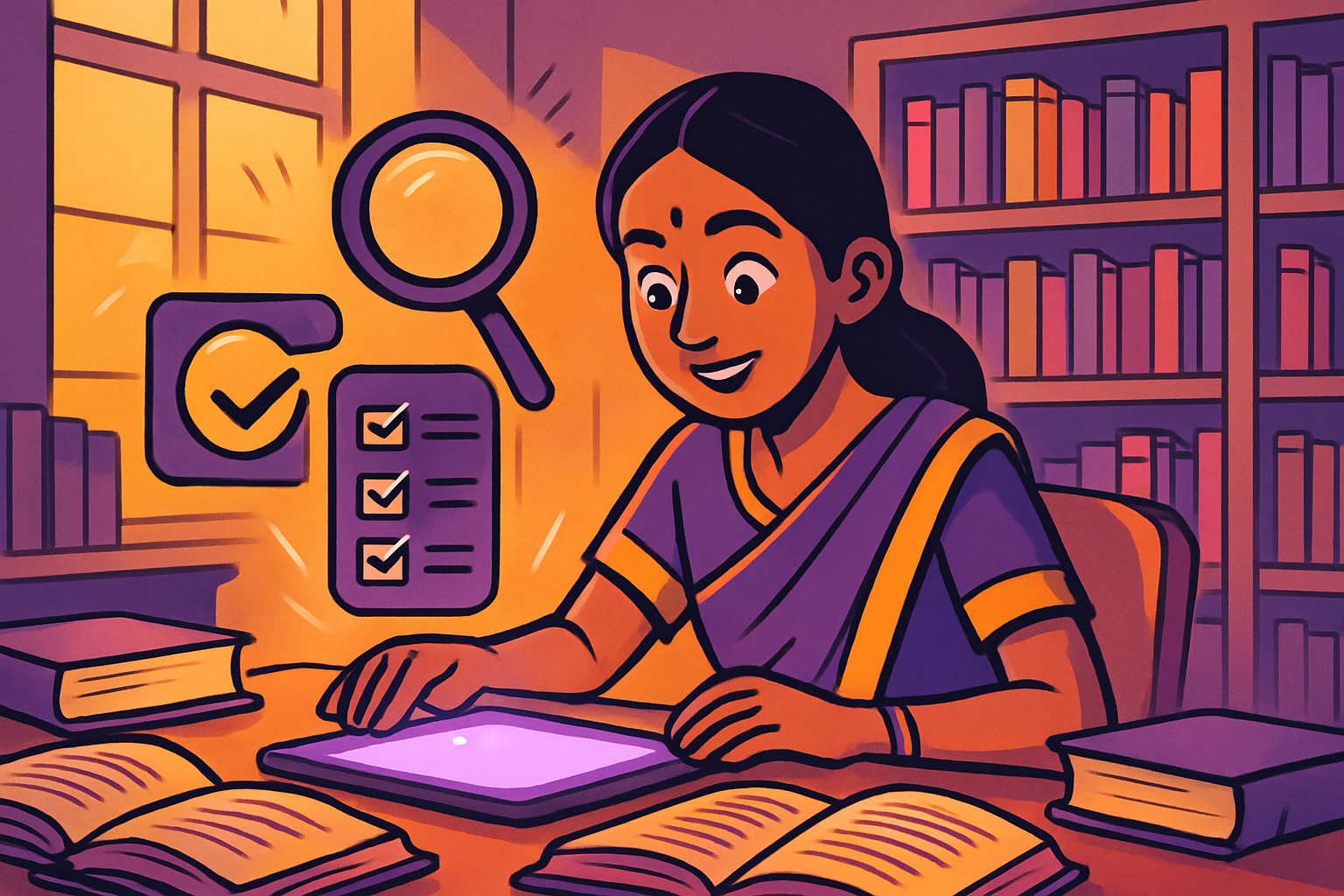
Kavya, 12, from Chennai, had a Geography project due in two days: "The water cycle and its importance for Indian agriculture." She typed the topic into AI and got back three paragraphs — detailed, well-written, and completely wrong in one key part. The AI had confused two different water-related processes and stated something that contradicted her Class 7 NCERT textbook.
If Kavya had copied those paragraphs directly, her teacher — who knew the chapter well — would have caught the error immediately. Instead, Kavya had learned something important: AI gives you a starting point, not a finished answer. Information always needs to be verified.
She went back to her textbook, confirmed the correct explanation, rewrote the project in her own words, and included a simple bibliography. Her teacher gave her top marks — not just for content, but for the way she had clearly thought through the topic herself.
👉 In this lesson you will learn the full research workflow that Kavya used — starting with AI, checking sources, and presenting information that is genuinely yours.
Section 1 of 8
🔑 The Research Rule: AI is a Starting Point, Not the Answer
When you research a topic for school, your job is to understand it well enough to explain it in your own words. AI is the fastest way to get an overview — a map of the topic — but a map is not the territory. The details, accuracy, and understanding must come from verified sources.
AI can be wrong about facts. AI generates text based on patterns — it does not look up a live database. It can state incorrect statistics, confuse similar concepts, mix up dates, or present outdated information as current. This is especially common for Indian-specific data (population figures, state information, recent events). Always verify with your textbook or a trusted source.
The right mental model: Think of AI as a very well-read but sometimes forgetful study partner. They give you a fast overview and point you in the right direction. But before you write anything down as fact, you check the original source yourself.
Section 2 of 8
🗺️ Step 1 — Get a Topic Overview from AI
The best first step for any research project is to ask AI for a broad overview. This gives you a map of the topic — what the main ideas are, what connects to what, and what you need to learn more about.
✅ Topic Overview Prompt
Give me a broad overview of the water cycle as it relates to Indian agriculture. Explain it like you are teaching a Class 7 student. Use simple language. List the 4–5 most important things I need to understand for a school project. Do NOT write my project for me — just give me a map of the topic.
The last sentence is important — it keeps AI in the "map" role, not the "write my project" role.
After reading the overview, write down in your own notebook:
What are the 4–5 main points AI mentioned?
Which ones do you already understand?
Which ones are new or confusing — and need more reading?
✅ Identify Gaps Prompt
Based on the overview you gave me about the water cycle and Indian agriculture, what are the 3 most important sub-topics that a Class 7 Geography project should cover? For each sub-topic, suggest one thing I should look up in my NCERT textbook to verify.
This prompt turns AI into a research guide — it tells you where to look, not what to think.
Section 3 of 8
✅ Step 2 — How to Judge a Source
Not all information is equally reliable. For school projects, you need to know which sources to trust and which to treat with caution.
✅ High trust
NCERT textbooks
Written and reviewed by education experts. This is the primary source for all Class 6–10 school projects in India.
✅ High trust
Government websites
India Meteorological Department, Census India, PIB (Press Information Bureau) — official data and reports.
⚠️ Check carefully
AI (ChatGPT, Gemini, etc.)
Good for overviews and explanations. Always verify specific facts, statistics, and claims against a textbook or official source.
⚠️ Check carefully
Wikipedia
Useful for general understanding. Not reliable for specific statistics or Indian-specific data. Check the references at the bottom.
❌ Use with caution
Random websites / blogs
No quality control. Anyone can publish anything. Never use as a sole source — always verify with a trusted source.
❌ Not a source
Social media / WhatsApp
Frequently contains misinformation. Never use for school projects. Always trace claims back to an original verified source.
✅ Fact Verification Prompt
You said that about 60% of India's agricultural land depends on monsoon rainfall. How confident are you in this figure? Can you tell me which official source or report this comes from, so I can verify it myself?
Asking AI to identify its source is powerful. If AI cannot name a specific source, treat the figure as unverified — look it up in your textbook or a government site.
Section 4 of 8
📖 Step 3 — Reading Long Texts Faster with AI
Sometimes you need to read a long chapter, a newspaper article, or a reference document for a project. AI can help you extract the most important information quickly — but you still need to understand it, not just copy the summary.
✅ Article Summary Prompt
Here is a long paragraph from my Geography textbook about the water cycle: [paste the paragraph]
Summarise this in 3 bullet points. Use simple language suitable for a Class 7 student. After the summary, tell me the one most important idea in this paragraph that I must not leave out of my project.
Asking for "the one most important idea" forces AI to prioritise, which helps you understand what matters most in the text.
✅ Difficult Word Prompt
In my textbook, I found this sentence: "Transpiration is the process by which water is carried through plants from roots to small pores on the underside of leaves, where it changes to vapour and is released to the atmosphere."
I understand most of it but I don't know what "transpiration" means compared to "evaporation". Explain the difference in one simple sentence each, with a daily-life example for each term.
Reading strategy — the 3-pass method:
First pass: Read the full section once without stopping. Get the general idea.
Second pass: Underline or note: key terms, important numbers, cause-effect relationships.
Third pass: For anything still unclear — ask AI to explain that specific part only.
Never paste your entire textbook into AI and ask it to summarise. This skips the reading entirely. You need to engage with the text yourself — AI should only explain the parts you genuinely didn't understand after reading.
Section 5 of 8
🔄 Step 4 — Cross-Checking and Fact-Checking
Cross-checking means verifying that a piece of information is confirmed by more than one reliable source. This is what journalists, scientists, and good researchers do — and it is a skill that will serve you your whole life.
1
Note the claimWrite down the specific fact or statistic you want to verify. Be exact — "India has X rivers" not just "India has many rivers."
2
Ask AI for its sourceUse the fact verification prompt. If AI cannot name a source, mark this fact as unverified.
3
Check your NCERT textbook firstYour textbook is written for your exact syllabus. If the fact is there, use the textbook version — not AI's version.
4
If not in textbook, search one official siteIndia Meteorological Department for weather/climate, Census India for population, MoEF for environment data.
5
If two sources agree → use it. If they disagree → note the uncertainty.It is perfectly valid to write: "Different sources give different figures. The NCERT textbook states [X]." This shows critical thinking.
The disagreement is actually good: When you find that AI says one thing and your textbook says another, that is the moment you learn the most. Ask AI: "My NCERT textbook says X. You said Y. Which is correct and why might there be a difference?" This kind of investigation is real research.
Section 6 of 8
✍️ Step 5 — Writing the Project in Your Own Words
After you have gathered and verified your information, it is time to write. The rule is the same as for creative writing: AI can help you structure and improve — but every sentence in the final project must be yours.
✅ Project Outline Prompt
I'm writing a Geography project on the water cycle and its importance for Indian agriculture. It should be about 400 words. Give me an outline with:
- A title
- 3–4 sections with one-line descriptions of what each section covers
I will write all the content myself. I just need a structure to follow.
✅ Own-Words Check Prompt
Here is a paragraph I wrote for my project: [paste paragraph]
Does this paragraph clearly explain the topic? Is there any sentence that is unclear or too complicated for a Class 7 project? Point out what to improve — do not rewrite it for me.
Writing rules for school projects:
Write in your own words — even if you understood something from AI, rephrase it as if you are explaining it to a friend
Use textbook vocabulary — your teacher knows the NCERT terms; use the same words the textbook uses for key concepts
One idea per paragraph — do not cram everything into one block of text; each section of your project should have a clear focus
Short is better than long and confusing — a clear 300-word project is better than a copied 600-word project that you don't understand
Section 7 of 8
📑 How to Cite Sources in School Projects
Citing a source means telling your reader where you got your information. For Class 7, a simple citation is enough — you do not need complex academic referencing. The important thing is honesty: you are showing that you did real research and you know where your information came from.
Simple citation format for Class 7:
For textbook: NCERT Class 7 Geography, Chapter 4 — Air, page 42
For website: India Meteorological Department, imd.gov.in, accessed May 2026
For AI: Overview generated using ChatGPT / Google Gemini, verified against NCERT textbook
Should you cite AI? Yes — if you used AI to understand a topic, say so briefly. Your teacher will respect the honesty far more than they would respect a copied AI paragraph with no source. Something like: "I used AI to understand the overview of this topic, then verified all key facts with the NCERT Class 7 Geography textbook."
✅ Bibliography Prompt
I've finished my project on the water cycle. The sources I used were:
1. NCERT Class 7 Geography, Chapter 4
2. India Meteorological Department website
3. AI for an initial overview (verified against textbook)
Help me write a simple 3-line bibliography for a Class 7 school project — not in complex academic format, just clear and honest.
Section 8 of 8
📋 The Full Research Workflow
Put it all together. Here is the complete 6-step research process for any school project:
Step
What you do
AI's role
1. Topic map
Ask AI for a broad overview. Read it and note the 4–5 main ideas.
Gives overview + suggests what to read in textbook.
2. Textbook first
Read your NCERT chapter using the 3-pass method.
Explains difficult words or sentences on request.
3. Fact check
For any statistic or specific claim, verify in textbook or official site.
Names its source — if it can't, you verify independently.
4. Outline
Ask AI for a structure. Make your own version of it.
Suggests section headings and flow.
5. Write
Write every sentence yourself in your own words.
Gives feedback on what to improve — does not rewrite.
6. Cite
Add a simple bibliography listing textbook, any websites, and AI (if used).
Helps format the bibliography in simple style.
Kavya's key insight: "The project where AI was wrong turned out to be the one I learned the most from. Because I had to go back to my textbook, look it up, and understand why AI got it wrong — I actually understood the water cycle better than I would have if AI had just been correct the first time."
🧠 Quick Quiz — Test Yourself!
10 questions · Click your answer · Check your score at the end
1. Kavya found that AI's information contradicted her NCERT textbook. What is the correct action?
2. What is the best way to use AI at the very start of a research project?
3. Which source is the MOST reliable for a Class 7 school project about Indian geography?
4. You want to verify a statistic AI gave you. What is the most effective first step?
5. In the 3-pass reading method, what is the purpose of the THIRD pass?
6. Should you mention AI in your project bibliography if you used it for research?
7. What is wrong with pasting your entire textbook chapter into AI and asking it to summarise it all at once?
8. When writing your project, which approach is correct?
9. AI says one fact and your textbook says a different fact. What does this tell you?
10. In the full research workflow, what happens in Step 5?
📝 Worksheet — Research Project Tracker
Tip: in the print dialog, choose "Save as PDF" to download.
Use this for your next school project. Complete each row as you work through the research process. Copy this table into your notebook.
Step
My project topic: _______________
Done? ✅/❌
1. AI topic map
Got an overview; listed 4–5 main ideas in my notebook
2. Textbook reading
Read relevant chapter using 3-pass method; noted key terms
3. Fact check
Verified at least 2 key facts — source: ___________
4. Outline
Created a structure (introduction + 3 sections + conclusion)
5. Write (own words)
Wrote every sentence myself; used textbook vocabulary
6. Bibliography
Listed textbook, any websites, and AI (if used)
Use this table in your notebook today, or print this page directly if helpful.
📋 Note for Parents and Teachers
What this lesson teaches: Students learn to use AI as a research starting point — not a finished answer. The lesson covers evaluating source reliability, the 3-pass reading method, cross-checking facts, writing in their own words, and citing sources (including AI) honestly. These are research skills used by journalists, scientists, and academics.
How to check at home:
Ask your child: "Where did you find this information?" If they can name a source (textbook chapter, website name), they did real research. If they say "AI", ask if they verified it anywhere else.
Ask them to explain one fact from their project in their own words. Students who did genuine research can do this easily.
The bibliography check: does the project list at least one source besides AI? A project with only "AI" as a source has not been properly verified.
For teachers: The fact-verification exercise (AI gives a statistic → student finds it in textbook or official site → student notes if it matches) makes an excellent 20-minute class activity that builds critical thinking and media literacy alongside research skills.