AI for Students · Class 8 · Age 12–13 · Lesson 8 of 12
AI Ethics and Society 🌐
AI raises hard questions about jobs, privacy, power, truth, and who decides. This lesson gives you a clear way to think through ethical dilemmas involving AI.
📘 Class 8 · Lesson 8🕐 50–60 min🚫 No coding needed🆓 Free lesson
Watch first · 2–3 minutes
Class 8 Lesson 8 — AI Ethics and Society
No sign-in needed · English narration · Safe for all school ages
Story · The AI Exam Grader Debate
Should AI Grade Our Exams? 📝
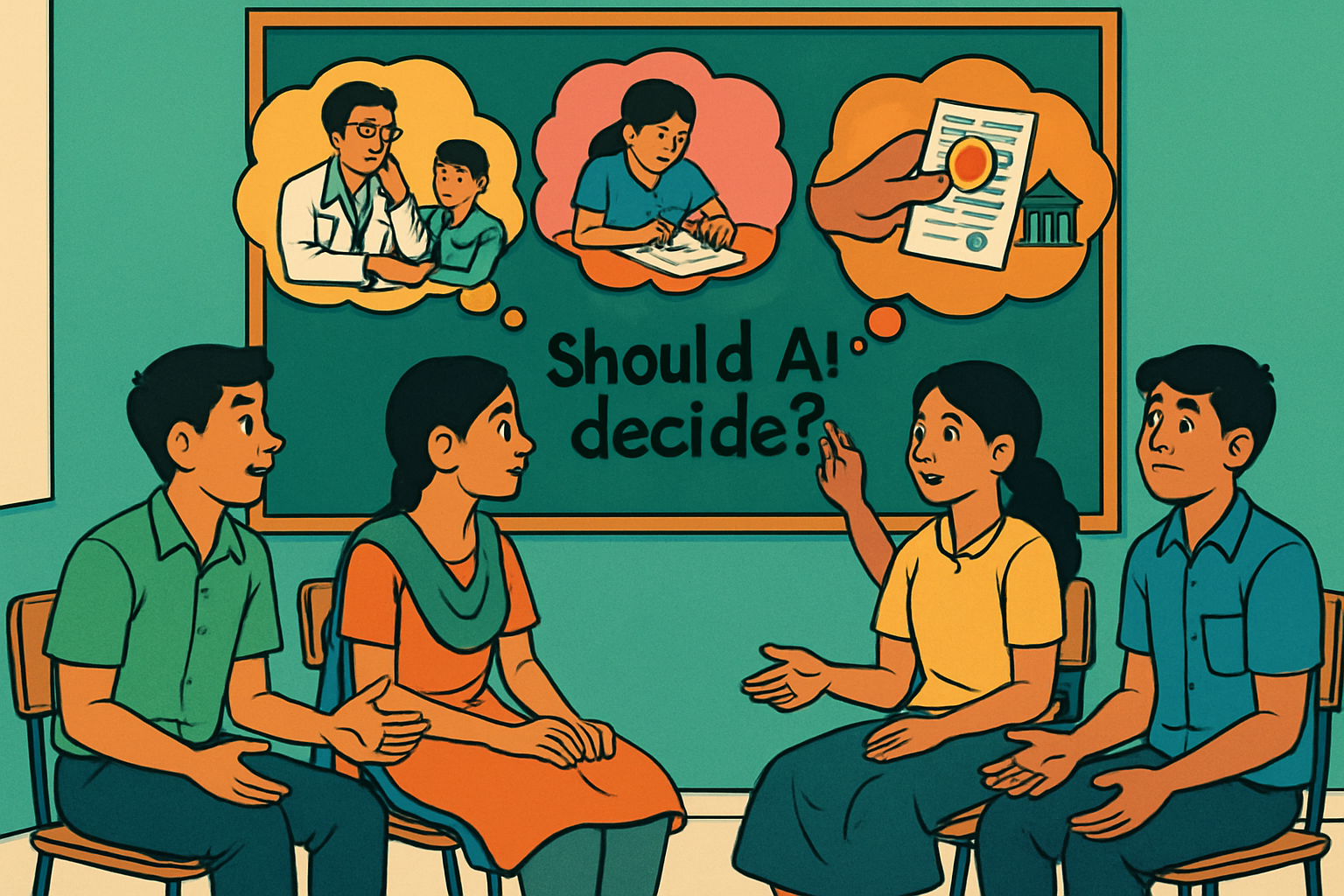
Sneha, 13, from Nagpur, heard that a private school in another city was piloting an AI system to grade Class 10 essay questions. The school said it was more consistent and faster than human teachers. Students would get results within minutes rather than weeks.
Her class got into a debate. "It would be faster and fairer — no teacher's mood affects your mark," said one student. Another disagreed: "How does an AI understand a creative answer? It probably penalises anything unusual." A third said: "If I fail, who do I appeal to?"
Sneha's teacher listened and then asked: "You have all raised important points. Let's make this more systematic. What values are in tension here — and which should we prioritise?"
👉 This lesson gives you exactly the tools Sneha's teacher was pointing to: a framework for identifying the ethical tensions in any AI decision and thinking through them clearly.
Section 1 of 5
🔥 Five Big Ethical Questions Raised by AI
💼
Jobs and Automation
AI can automate tasks done by humans — data entry, basic writing, image sorting, customer service, some legal and medical diagnosis tasks. Who benefits when productivity rises? Who loses when jobs disappear? How fast is change happening? What support exists for people displaced?
🔒
Privacy
AI systems need large amounts of personal data to work well. Every time you use a health app, a smart speaker, or a navigation system, data about you is collected and analysed. Who owns this data? How is it stored? Who can access it? Can you have it deleted?
📹
Surveillance
AI enables surveillance at scales previously impossible — face recognition across millions of cameras, predictive policing, tracking of social media for dissent. Even if each camera is legal, the combined system can enable a kind of social control that fundamentally changes how people behave in public spaces.
🎭
Deepfakes and Misinformation
AI can now generate convincing fake videos, voices, and images of real people. A political leader can appear to say something they never said. A private individual's face can be placed in a video without consent. This creates new threats to truth, reputation, and democratic processes.
🤖
Autonomy and Human Oversight
When AI makes decisions — about credit, medical diagnosis, criminal sentencing, or hiring — how much control should humans retain? If AI is more accurate, is human oversight still valuable? Or does removing human oversight remove the ability to question, appeal, and hold systems accountable?
Section 2 of 5
🚃 The Trolley Problem and AI Decisions
Philosophers use the "trolley problem" to explore how we make decisions when values conflict. Here is an AI version:
Scenario: A self-driving car's brakes fail on a hill. It can either swerve into a wall (killing the passenger) or continue straight (hitting a group of 5 pedestrians). The AI must decide in milliseconds.
The questions this raises:
Should the car always protect the passenger, the majority, or random chance?
Who should programme the ethics of the car — the manufacturer, the government, or the buyer?
If the car is programmed to minimise total casualties, it might be programmed to sacrifice its own passenger. Would you buy that car?
Should different countries have different ethical rules programmed into the same car?
There are no universally agreed answers to these questions. But working through them is important — because these decisions are being made right now, by AI companies and governments, often without public consultation.
Section 3 of 5
🇮🇳 India AI Mission 2024: Context and Stakes
India announced the India AI Mission in March 2024 with a budget of ₹10,372 crore (approximately $1.25 billion). This is one of the world's largest national AI infrastructure programmes. It includes:
AI compute infrastructure: 10,000+ GPUs to be made available to startups, researchers, and government through a centralised compute platform
IndiaAI Dataset Platform: Large curated datasets in Indian languages and domains (agriculture, health, education) to train India-specific AI models
AI safety and ethics framework: Development of standards for responsible AI deployment in Indian context
FutureSkills Prime expansion: Upskilling millions of workers in AI-adjacent skills
Why this matters for you: India's AI policy choices will directly shape your future — what jobs exist, how your health data is used, whether AI systems serving you are fair and explainable. These decisions are shaped by public discourse. The more citizens — including students — understand AI, the better the policy will be.
AI Regulation: Global context
Region
Key AI regulation development
European Union
EU AI Act (2024) — world's first comprehensive AI law. Bans certain uses (social scoring, real-time biometrics in public), regulates high-risk AI (hiring, credit, medical)
United States
Executive Order on AI Safety (2023) — guidelines for federal AI use, safety testing for frontier models
India
No standalone AI law yet. Digital Personal Data Protection Act 2023 governs data. India AI Mission 2024 includes ethics framework development. Voluntary guidelines for AI intermediaries.
China
Rules on algorithmic recommendation (2022), generative AI regulation (2023) — requires labelling of AI-generated content
Section 4 of 5
🧭 A 4-Step Ethical Reasoning Framework
When faced with an ethical question about AI — in a debate, an assignment, or real life — use these four steps:
1
Identify the stakeholders. Who is affected by this AI decision? List all of them — not just the obvious ones. For AI exam grading: students, teachers, parents, school management, universities reviewing results, future employers. Each group may have different interests.
2
Name the competing values. What values are in tension? Common tensions in AI ethics: efficiency vs fairness, privacy vs security, innovation vs caution, individual benefit vs collective risk, transparency vs commercial secrecy. Name both sides.
3
Identify who bears the risks vs who gets the benefits. AI benefits and harms are often distributed unequally. Does this system benefit one group while creating risks for another? If so, who has less power to protect themselves?
4
Propose a safeguard, not just a verdict. Rather than just saying "AI grading is good" or "AI grading is bad," propose a condition: "AI grading could be used IF there is a clear human appeal process, IF the model is audited for bias across groups, and IF its confidence score is reported alongside the grade."
Apply the framework: Try it on the AI exam grader scenario from the story. Work through all 4 steps in your notebook. Compare with a classmate — do you arrive at the same safeguards?
Section 5 of 5
🗺️ Key Vocabulary Summary
Term
Simple meaning
AI ethics
The study of the moral principles that should guide the design, deployment, and use of AI systems
Deepfake
AI-generated media — video, audio, or image — that convincingly shows someone doing or saying something they did not actually do or say
Surveillance
Monitoring of individuals' behaviour, location, or communications — AI enables surveillance at unprecedented scale
Human oversight
The presence of humans in the decision loop — able to review, question, and override AI system decisions
Stakeholder
Any person or group affected by a decision or system
Safeguard
A condition, rule, or process that limits harm while allowing a system to operate — e.g. "AI can be used for X, but only IF these conditions are met"
🌐 Quiz — Lesson 8
8 questions · Click your answer · Submit for your score
1. The debate in the story about AI grading exams involves which two competing values?
2. A deepfake is:
3. Why is mass surveillance through AI cameras an ethical concern, even if each individual camera is legal?
4. In the 4-step ethical reasoning framework, Step 3 asks you to:
5. The EU AI Act (2024) is significant because it:
6. The ethical framework says you should "propose a safeguard, not just a verdict." This means:
7. The India AI Mission (2024) includes which of the following?
8. When an AI system replaces a human decision-maker, one key thing that is often lost is:
📝 Worksheet — Apply the Ethics Framework
Tip: in the print dialog, choose "Save as PDF" to download.
Choose one of the two scenarios below. Apply the 4-step framework in your notebook:
Scenario A: A bank wants to use an AI system to decide whether to approve loans for small businesses. The system was trained on past loan performance data and considers factors including the business location and the owner's previous banking history.
Scenario B: A city government wants to use AI to predict which students are at risk of dropping out of school so that counsellors can intervene early. The system would use attendance records, grades, and data from the national student database.
List all stakeholders (people affected by the system).
Name the two main competing values in this scenario.
Identify who bears the most risk and who gets the most benefit. Are these the same people?
Propose two specific safeguards that would make this system more ethical. Use "the AI can be used IF…" format.
📋 Note for Parents and Teachers
What this lesson covers: Five major ethical questions raised by AI (jobs, privacy, surveillance, deepfakes, autonomy); the trolley problem applied to AI decision-making; India AI Mission 2024 context and global regulatory landscape; a 4-step ethical reasoning framework (stakeholders → competing values → risk/benefit distribution → safeguard proposal). This lesson builds structured reasoning skills alongside AI knowledge.
Discussion prompts:
"Sneha's classmates had different views on AI exam grading. Which view do you find most convincing? What would change your mind?"
"India does not yet have a comprehensive AI law. Do you think it needs one? What should it cover?"