Building AI Startups in India ๐Ÿš€

Class 11Age 15โ€“16Lesson 11 of 12๐Ÿ†“ Free
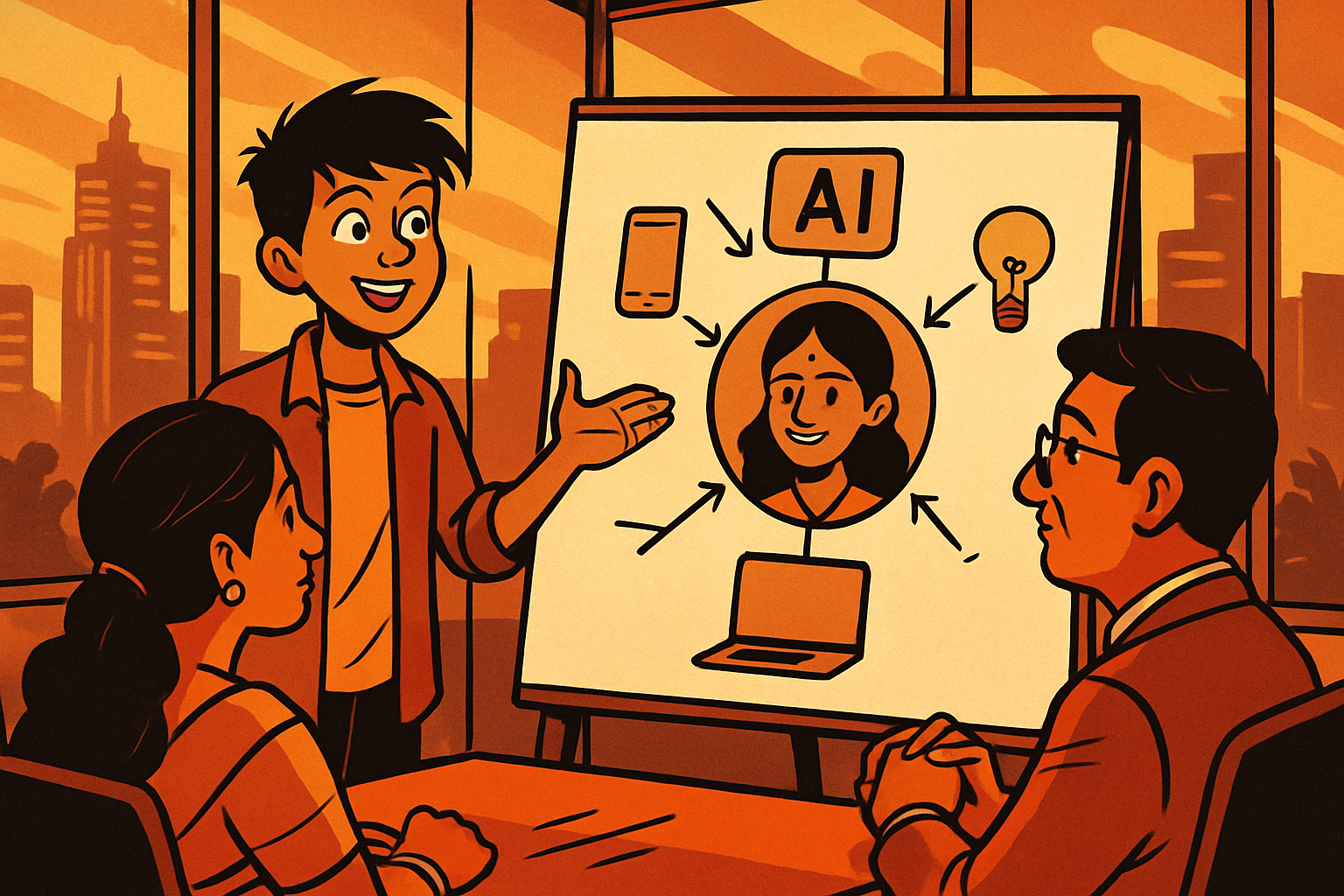
Rahul from Chandigarh pitching his agri-advisory AI startup โ€” pitch canvas on whiteboard, Indian farmer using phone app, startup ecosystem logos
Watch first - 2-3 minutes

Class 11 Lesson 11 - Building AI Startups in India

No sign-in needed - English narration - Safe for all school ages

Story
Rahul's Agri-Advisory AI Startup

Rahul, 16, from Chandigarh grew up watching his family's farm neighbours struggle. Despite India being the world's second largest agricultural producer, smallholder farmers had almost no access to personalised crop-advisory โ€” which fertiliser for which soil, when to irrigate, early detection of crop disease.

After completing Lessons 1โ€“10, Rahul had an idea: a voice-first AI app that a farmer could talk to in Punjabi and get specific, science-backed advice for their exact crop, location, and season. Satellite soil data + a fine-tuned multilingual LLM + Whisper.

"How do I know if this is a real startup or just a cool demo?" he asked. His entrepreneurship teacher pointed him to three things: talk to farmers, calculate your economics, and check if India already has this.

Section 1
Problem Validation: Jobs-to-be-Done Framework

Clayton Christensen's Jobs-to-be-Done (JTBD) framework asks: What "job" does the customer hire a product to do? Customers do not buy products โ€” they hire them to make progress in their lives.

# Rahul's JTBD analysis for the agri-advisory app

JTBD_CANVAS = {
    "situation": "When I notice my wheat leaves turning yellow in Week 3",
    "motivation": "I want to quickly know if this is nitrogen deficiency or rust disease",
    "expected_outcome": "So I can take the right action today before it spreads and reduces my yield",

    # Current "hired" solutions and their frustrations:
    "current_solutions": [
        "Call the government Krishi Helpline โ€” average 45-minute wait, advice is generic",
        "Ask a neighbour โ€” may have wrong information or different soil type",
        "Pay a private agricultural consultant โ€” โ‚น500+ per visit, unaffordable for 2-acre farms",
        "Search Google โ€” results in English, no context about local conditions"
    ],

    # What the app does better:
    "switching_criteria": [
        "Responds in Punjabi immediately (zero wait time)",
        "Uses satellite soil data for my specific field coordinates",
        "Provides photo-diagnosis: take a photo of the leaf, get instant assessment",
        "Costs less than a phone call to a consultant"
    ]
}

# The insight: the job is not "get agricultural information"
# The job is "make a high-stakes farming decision with confidence in 5 minutes"
# This specificity changes what the product needs to be.
Validate before building. Before writing any code, Rahul interviewed 15 farmers in a village near Chandigarh. He asked: "When you have a crop problem, what do you do?" not "Would you use an AI advisory app?" People say yes to hypothetical products. They reveal real pain in describing real behaviour.
Section 2
Unit Economics for AI Products

AI products have different economics from traditional software. Inference costs money per query โ€” you cannot just build once and serve for free.

MetricDefinitionRahul's Estimate
CAC (Customer Acquisition Cost)Total marketing spend / new customers acquiredโ‚น120 per farmer (WhatsApp group + field demo)
LTV (Lifetime Value)Revenue per customer ร— average retention monthsโ‚น50/month ร— 8 months = โ‚น400
LTV:CAC ratioMust be โ‰ฅ 3x for a sustainable businessโ‚น400 / โ‚น120 = 3.3x โœ…
Inference cost per queryLLM API cost for one user question~โ‚น0.50 (GPT-4o-mini at current prices)
Queries per user per monthAverage from pilot users~30 queries/month
Monthly inference cost per userInference cost ร— queriesโ‚น15/month (30% of โ‚น50 revenue)
Gross margin(Revenue โ€“ inference cost) / Revenue(50 โ€“ 15) / 50 = 70%
# Unit economics calculator
def calculate_ai_unit_economics(
    revenue_per_user_monthly: float,
    queries_per_user_monthly: int,
    cost_per_query: float,
    other_variable_costs_monthly: float,
    cac: float,
    avg_retention_months: int
) -> dict:
    inference_cost = queries_per_user_monthly * cost_per_query
    total_variable = inference_cost + other_variable_costs_monthly
    gross_margin_pct = (revenue_per_user_monthly - total_variable) / revenue_per_user_monthly * 100

    ltv = revenue_per_user_monthly * avg_retention_months * (gross_margin_pct / 100)
    ltv_cac_ratio = ltv / cac

    return {
        "gross_margin_%":        round(gross_margin_pct, 1),
        "ltv":                   round(ltv, 2),
        "ltv_cac_ratio":         round(ltv_cac_ratio, 2),
        "payback_months":        round(cac / (revenue_per_user_monthly * gross_margin_pct / 100), 1),
        "sustainable":           ltv_cac_ratio >= 3.0
    }

result = calculate_ai_unit_economics(
    revenue_per_user_monthly=50,
    queries_per_user_monthly=30,
    cost_per_query=0.50,
    other_variable_costs_monthly=5,
    cac=120,
    avg_retention_months=8
)
print(result)
# {'gross_margin_%': 70.0, 'ltv': 280.0, 'ltv_cac_ratio': 2.33, ...}
# LTV:CAC = 2.33 โ€” below 3x. Need to reduce CAC or increase retention.
AI inference costs drop fast. GPT-4o-mini is 100x cheaper than GPT-4 was in 2023. Open-source models (Llama, Mistral) can run on cheap cloud GPU for even less. Model your economics at current prices, then check if the business still works at 2x the current cost as a stress test.
Section 3
India's AI Startup Ecosystem

iSPIRT Foundation

India Software Product Industry Round Table. Open-source public digital infrastructure (India Stack: Aadhaar, UPI, ONDC). Strong community for Indian product builders.

Nasscom AI

India's largest tech industry body. Nasscom CoE (Centre of Excellence) in AI provides mentorship, office space, and corporate pilot opportunities for AI startups.

Meity Startup Hub

Ministry of Electronics and IT's startup initiative. Provides grants, computing credits, and connections to government use-cases. Apply at startup.msme.gov.in.

IIIT-H CIE

IIIT Hyderabad's Centre for Innovation and Entrepreneurship. Accepts student startups from across India. Strong AI research collaboration network.

Funding stages for Indian AI startups:

Section 4
1-Page Pitch Canvas
1-PAGE AI STARTUP PITCH CANVAS
Problem (JTBD)
When a smallholder farmer sees a diseased crop, they spend 45 min on hold to get generic advice โ€” risking โ‚น40,000 in crop loss.
Solution
Voice-first AI in Punjabi. Photo + 30-second question โ†’ specific diagnosis + treatment. Uses satellite soil data for personalisation.
Target Customer
Smallholder wheat/rice farmers in Punjab, 1โ€“5 acres. Age 30โ€“55. Feature phone or basic Android. Punjabi as primary language.
Unique Advantage
Only Punjabi-first agri-AI with per-field satellite soil integration. No competitor speaks the language AND knows the soil.
Business Model
โ‚น50/month subscription or pay-per-query at โ‚น2. B2B2C via Farmer Producer Organisations (FPOs).
Traction / Evidence
15 farmer interviews. 5 pilot users for 3 weeks. 94% found advice accurate. NPS: 72.
Ask
โ‚น15L angel round for 6-month runway: GPU credits, field team in 2 districts, 50-farm paid pilot.
Unit Economics
CAC โ‚น120 | LTV โ‚น400 | LTV:CAC 3.3x | Gross margin 70% | Payback 3 months
Team
Rahul โ€” AI/ML (IIT JEE aspirant). Harpreet โ€” agronomy domain knowledge (farmer's son). Advisor: Prof. X, ICAR.
IP for AI startups: In India, software and algorithms are generally not patentable (Patents Act ยง3(k) excludes computer programs per se). Your moat is data, distribution, and domain expertise โ€” not IP protection. Trade secrets (keeping your training data and fine-tuning pipeline confidential) are more practical than patents for most AI startups. Register your trademark early (โ‚น4,500 per class at ipindia.gov.in).

๐Ÿš€ Lesson 11 Quiz โ€” Building AI Startups in India

1. The Jobs-to-be-Done framework reframes the question from "would users like this feature?" to "what job is the user hiring this product to do?" The advantage is:
a) JTBD eliminates the need for user interviews by deriving requirements from first principles
b) It focuses product development on the real outcome users want (make a confident farming decision in 5 minutes) rather than the feature surface (an AI chatbot). This prevents building a technically impressive product that nobody hires because it doesn't solve the specific job with enough reliability. The competitor set also becomes clearer: you compete with WhatsApp groups and phone calls, not other AI apps.
c) JTBD predicts which customer segments will pay the most for the product
d) The framework is only applicable to consumer products, not B2B or agricultural use cases
2. Rahul's initial unit economics show LTV:CAC = 2.33x โ€” below the 3x sustainable threshold. The most efficient lever to improve this ratio is:
a) Reduce inference costs by switching to a smaller model
b) Increase retention (average months users stay). LTV = Revenue ร— Retention ร— Gross Margin. Doubling retention from 8 to 16 months would bring LTV:CAC to 4.6x without changing prices or acquisition costs. Retention improvement is earned through product quality โ€” better advice means farmers return. It compounds with all other improvements.
c) Raise the subscription price from โ‚น50 to โ‚น100 immediately
d) Reduce the team size to lower operational expenses
3. Meity Startup Hub and Nasscom CoE provide computing credits and government pilot opportunities to AI startups. The strategic value for an early-stage startup is:
a) Government partnerships automatically ensure the startup becomes profitable
b) Computing credits reduce the most dangerous early cost (GPU inference) without diluting equity. Government pilot opportunities provide paying reference customers with meaningful scale (e.g., 10,000 farmers via a state agriculture department), which both validates the product and provides data to improve the model โ€” creating a compounding advantage over competitors starting from zero.
c) These programmes guarantee a Series A investment from government-linked VCs
d) Nasscom membership provides legal protection from patent infringement claims
4. India's Patents Act ยง3(k) excludes computer programs per se from patentability. The practical implication for an AI startup whose main innovation is a novel training pipeline is:
a) The startup cannot protect its innovation at all โ€” it will be immediately copied
b) The moat must come from data, distribution, and domain expertise rather than patents. Keep the training data (15 farmer interviews, soil sensor data, ground truth labels) and fine-tuning methodology as trade secrets. First-mover advantage in acquiring proprietary agricultural data creates a defensible position โ€” competitors would need years to replicate the dataset even if they know your model architecture.
c) Register the startup internationally in the US where software patents are allowed
d) Partner with a research institution so the patent can be filed under their name
5. The pitch canvas uses "94% found advice accurate" as a traction metric. A sophisticated investor would ask for clarification because:
a) Investors only care about revenue numbers, not accuracy metrics for AI products
b) "Found advice accurate" is self-reported user satisfaction โ€” not the same as agronomically verified accuracy. The investor would want to know: who assessed accuracy (the farmers themselves or an independent agronomist?), what was the denominator (94% of 5 users ร— 3 queries is only 14 data points), and what was the consequence of the 6% inaccurate advice. Rigorous pilot design separates a promising demo from a real product.
c) 94% accuracy is below the 99% threshold required for agricultural advisory products
d) The metric should be reported as precision and recall separately, not combined accuracy
6. A Seed-stage VC offers โ‚น1Cr for 20% equity. This implies a post-money valuation of โ‚น5Cr. Before accepting, the most important calculation is:
a) Whether the valuation is higher than competitors who raised in the last 12 months
b) How many months of runway โ‚น1Cr provides, and whether the milestones achievable in that runway justify the next funding round at a higher valuation. At โ‚น5L/month burn rate, โ‚น1Cr = 20 months. You need to show 10x revenue growth in that period to raise Series A. If the plan requires 36 months to prove product-market fit, this round is too small and the pressure to raise again in 20 months will distort product decisions.
c) Whether the VC has agriculture sector expertise listed on their website
d) The exact stock option pool percentage that should be set aside for future employees
7. Rahul's B2B2C model โ€” selling through Farmer Producer Organisations (FPOs) rather than directly to individual farmers โ€” is a strategic choice because:
a) FPOs have regulatory authority to approve agricultural software in India
b) FPOs aggregate hundreds to thousands of farmers in a trusted institutional relationship. One sales conversation with an FPO can activate 500 farmers, reducing CAC from โ‚น120 per farmer to potentially โ‚น5-10 per farmer. FPOs also provide distribution infrastructure (WhatsApp groups, field meetings) and credibility โ€” farmers trust advice coming through their existing FPO more than an unknown app.
c) Direct-to-farmer sales require a pharmaceutical license from the government
d) FPOs provide crop insurance data that is legally required to operate an advisory service
8. Before building any code, Rahul interviewed 15 farmers and asked "when you have a crop problem, what do you do?" rather than "would you use this AI app?" The reason for this specific question framing is:
a) Open-ended questions are required by IRB protocols for research involving agricultural workers
b) Asking about existing behaviour reveals actual pain points with current solutions (45-minute hold times, generic advice, language barriers, high consultant cost). Asking about a hypothetical product triggers social desirability bias โ€” people say yes to sound supportive. Behaviour data reveals the real job and the real competitor, which determines whether your solution is genuinely 10x better or just marginally different.
c) Technology-specific questions are too jargon-heavy for non-technical farmer interviews
d) Asking about behaviour instead of product features keeps the NDA liability contained to the interviewer
โ† Lesson 10: AI Safety Lesson 12: Capstone โ†’