AI for Students · Class 7 · Age 11–12 · Lesson 3 of 12
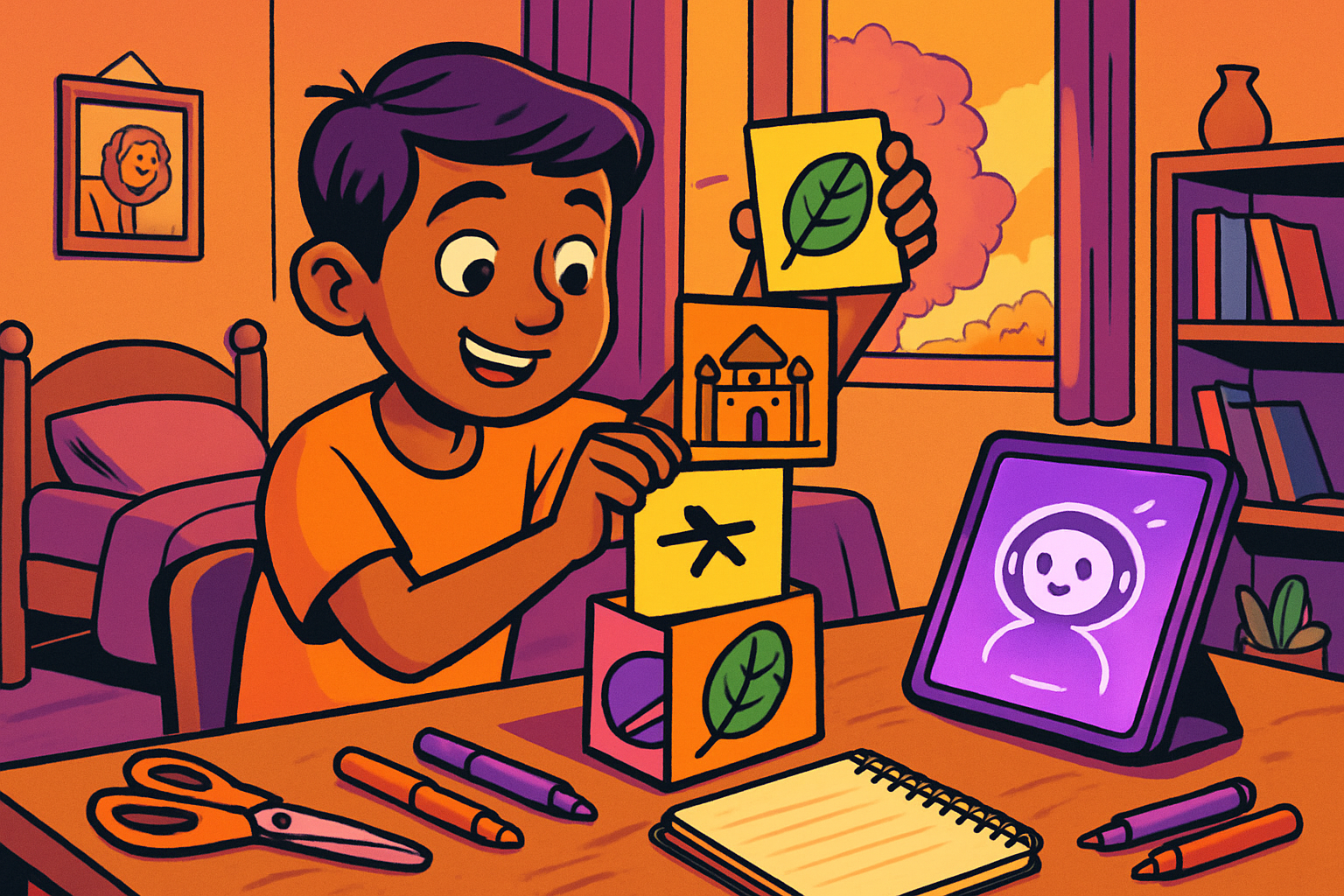
Build Your Own Revision Kit 🃏
Make AI-powered flashcards, self-quizzes, chapter summaries, and a revision timetable — tools you will actually use before exams.
📘 Class 7 · Lesson 3🕐 45–60 min🚫 No coding needed🆓 Free lesson
Watch first · 2–3 minutes
Class 7 Lesson 3 — Build Your Revision Kit
No sign-in needed · English narration · Safe for all school ages
Story · Arjun's Exam Week
The Night Before the Science Exam 😰
It was Sunday evening. Arjun's Science unit test was on Monday morning — in less than 14 hours. He had read the chapter three times, but every time he closed the book, the facts seemed to disappear from his head.
"I know I read it," he told Diya on the phone. "But I can't remember the order of the digestive system. Everything is mixing up."
"Did you try making flashcards?" Diya asked. "Not just reading — active revision?"
Arjun had heard of flashcards but never actually made them. "That will take hours," he said.
"Not with AI," Diya replied. "I'll show you. Open a chat with any AI tool. We can build your entire revision kit in 30 minutes."
Arjun scored 23 out of 25 the next morning.
👉 In this lesson, you will learn Diya's exact technique — how to build a complete revision kit using AI in under an hour.
Section 1 of 8
📋 What Goes Into a Revision Kit?
A revision kit is a set of personalised study tools made from your specific textbook chapter. It is not the same as re-reading. Active revision — where you test yourself, recall facts, and check your own answers — is much more powerful than passive reading.
A complete revision kit has five parts:
Chapter summary — the whole chapter in 10 bullet points
Key terms list — important words and their definitions
Flashcard set — question on front, answer on back
Self-quiz — 10 questions to test yourself
Exam-style questions — 2–3 longer questions like your actual paper
Why this works: When you create revision tools yourself, you are already revising. The act of writing out key terms, reviewing a summary, and answering quiz questions forces your brain to process the information actively — not just scroll past it.
Section 2 of 8
📄 Step 1 — AI Chapter Summary
Start every revision session by asking AI for a clear, structured summary of your chapter. This gives you an overview before you go into the details.
✅ Chapter Summary Prompt
Summarise Chapter 2 — "Nutrition in Animals" from the NCERT Class 7 Science textbook in exactly 10 bullet points. Each point should be one sentence. Use simple language suitable for a Class 7 student in India.
Why it works: specifies the exact chapter, asks for exactly 10 bullet points, and sets the reading level clearly.
✅ Key Terms Prompt
List the 8 most important terms from "Nutrition in Animals" (Class 7 NCERT Science Chapter 2). For each term, give a definition in one simple sentence. Format it as a numbered list.
Always check: After AI gives you a summary, open your textbook and quickly confirm the main facts are correct. AI may occasionally miss a section or merge two concepts. Your textbook is the source of truth for your exam.
Take what AI gives you and write it in your own notebook — do not just screenshot it
Reading and writing helps you remember far better than just reading on a screen
Add your own examples next to each point to make it personal and memorable
Section 3 of 8
🃏 Step 2 — Make Flashcards with AI
Flashcards are the most powerful revision tool for facts, definitions, and processes. The front of each card is a question; the back is the answer. You shuffle them, test yourself, and repeat the ones you get wrong.
✅ Flashcard Set Prompt
Create 10 flashcards for "Nutrition in Animals" (Class 7 NCERT Science). Format each card as:
Front: [question]
Back: [short answer]
Make the questions test understanding, not just memorising. Include 2 cards about processes, 4 about key terms, and 4 about facts.
Why it works: tells AI the exact format, the number of cards, and the type of questions — so you get a balanced set, not 10 definition questions in a row.
Here is an example of what good AI-generated flashcards look like:
Front — Question
What is the role of villi in the small intestine?
Back — Answer
Villi are tiny finger-like projections that increase the surface area of the small intestine, allowing nutrients from digested food to be absorbed into the blood more efficiently.
Front — Question
Name the enzyme in saliva and what it digests.
Back — Answer
Salivary amylase. It begins the digestion of starch (carbohydrates) in the mouth.
How to actually use flashcards:
Read the question on the front
Try to answer from memory without looking
Flip and check — mark it ✅ if correct, ❌ if not
Go through all cards once, then repeat only the ❌ cards
Repeat until you can answer all cards correctly twice in a row
Physical flashcards are better than digital: Writing the question and answer onto actual paper cards takes more time — but that writing process itself is revision. Cut up old notebooks or use index cards.
Section 4 of 8
❓ Step 3 — Generate a Self-Quiz
A self-quiz is a set of short questions you answer on paper without looking at your notes. When you check your answers afterwards, you instantly know which topics need more revision.
✅ Self-Quiz Prompt
Create a 10-question self-quiz on "Nutrition in Animals" (Class 7 NCERT Science). Include:
- 4 fill-in-the-blank questions
- 3 true or false questions
- 2 short-answer questions (1–2 sentences)
- 1 diagram-label question (describe what to label — I will draw it)
At the end, add an answer key.
Why it works: mixing question types is more effective than 10 identical MCQs. The diagram question is also excellent practice for board exams.
How to use a self-quiz properly: 1. Print or copy the questions — do NOT have the answers visible.
2. Set a 10-minute timer and answer from memory.
3. After time is up, check every answer against the key.
4. Topics where you scored less than 50% → read your textbook again, then ask AI to explain that specific section.
Section 5 of 8
📝 Step 4 — Exam-Style Practice Questions
Most Indian school exams have 2-mark, 3-mark, and 5-mark answer questions. AI can generate these so you can practise writing full answers in the format your teacher expects.
✅ Exam Question Prompt
Give me exam-style questions for "Nutrition in Animals" (Class 7 NCERT Science), like a CBSE or APSC paper:
- 2 questions worth 2 marks each (short answers)
- 1 question worth 3 marks
- 1 question worth 5 marks (detailed explanation)
After each question, add a model answer in the typical exam answer style. I will cover the model answers and write my own first.
After practising, compare your answer to AI's model answer:
Did you cover all the main points?
Did you use the correct technical terms?
Was your answer the right length for the marks?
Important: AI model answers may differ slightly from what your specific teacher or board expects. Always read 2–3 solved examples from your textbook or past papers alongside AI-generated model answers.
Section 6 of 8
🗓️ Step 5 — Build a Revision Timetable
Having all the revision tools in the world is useless if you run out of time. AI can help you build a realistic, manageable timetable for your exam preparation period.
✅ Revision Timetable Prompt
I have 7 days before my Class 7 half-yearly exams. My subjects are: Science (3 chapters), Maths (2 chapters), History (2 chapters), Geography (1 chapter), English (grammar + essay), and Hindi (vocabulary + grammar). I can study for 2 hours each day. Build me a 7-day revision timetable. Include one full rest day. Format it as a simple table.
Why it works: gives AI real numbers — days available, study hours, number of chapters — so it creates a usable plan rather than a generic schedule.
Make the timetable work:
Tell AI your actual constraints — how many hours per day, which subjects are harder for you
Ask AI to schedule harder subjects in the morning when your mind is fresh
Always include buffer time — exams take longer than expected
Stick the timetable on your wall or desk where you can see it every day
Arjun's key lesson: The timetable only works if you actually follow it. Tell a parent or friend about your plan — when someone else knows your schedule, you are much more likely to stick to it.
Section 7 of 8
🔁 The Spaced Repetition Method
Scientists have discovered that the best way to remember something is to review it just as you are about to forget it — not immediately after you learn it. This is called spaced repetition.
Here is a simple version you can use with your AI-generated flashcards:
D1
Day of studyingGo through all flashcards. Mark each one ✅ or ❌.
D2
Next dayReview only the ❌ cards from Day 1. Update marks.
D5
3 days laterGo through all cards again. This is the key review — your brain has started to forget and reviewing now locks it in.
D10
A week laterFinal full review. Any card you still get wrong needs more attention — ask AI to explain that concept in a different way.
✅ Explain Differently Prompt
I keep forgetting how villi work in the small intestine. Can you explain it to me in a completely different way — maybe using an analogy to something from Indian daily life? Something like a market, a sponge, or a strainer.
If one explanation isn't sticking, a different analogy often helps. This prompt asks for a fresh angle.
Section 8 of 8
🗂️ Organise Your Revision Kit
Building tools is only half the job — you also need to organise them so you can find them quickly before an exam. Here is a simple system:
The Revision Kit Folder System: Use one notebook or folder per subject. Inside each, have four sections:
1. Summary sheets — one page per chapter (AI-generated summaries written in your own hand)
2. Key terms — vocabulary lists, definitions in your own words
3. Flashcards — paper cards clipped together by chapter (not loose!)
4. Quiz results — record of each self-quiz: date, score, topics to revise
One more powerful technique: the teach-it-back test.
After completing a chapter's revision kit, close everything and explain the chapter out loud to yourself, a family member, or a friend — as if you were teaching them. If you can teach it clearly without notes, you have genuinely understood it. If you get stuck, that tells you exactly which part still needs work.
Diya's final tip: "I make my revision kit the week before exams start, not the night before. The night before, I only use the kit I already built. That way I'm calm, and everything is already organised."
🧠 Quick Quiz — Test Yourself!
10 questions · Click your answer · Check your score at the end
1. What are the five parts of a complete revision kit, as taught in this lesson?
2. Which flashcard prompt will give you the most useful and balanced set of flashcards?
3. Arjun receives an AI chapter summary but does not check his textbook. Why is this risky?
4. When should you do your final revision using the kit you built?
5. What is spaced repetition?
6. You score 4/10 on your Science self-quiz. What should you do next?
7. Why is writing revision notes on paper better than just reading them on a screen?
8. Which revision timetable prompt will get the most useful result from AI?
9. What is the "teach-it-back test" described in Section 8?
10. An exam-style practice question prompt asks for 2-mark, 3-mark, and 5-mark questions. Why is this specific format useful?
📝 Worksheet — Build One Chapter's Revision Kit
Tip: in the print dialog, choose "Save as PDF" to download.
Pick one chapter you are currently studying. Use AI to build each of the 5 revision tools. Record your prompts and results below. Copy this table into your notebook.
Tool
Chapter / Subject
Prompt you used
Quality of AI output? (Good / OK / Poor)
Chapter summary (10 bullets)
Key terms list (8 terms)
Flashcard set (10 cards)
Self-quiz (10 questions)
Exam-style questions (2–3)
Use this table in your notebook today, or print this page directly if helpful.
📋 Note for Parents and Teachers
What this lesson teaches: Students learn to use AI to actively build revision tools — not to passively receive answers. The lesson emphasises that writing by hand, self-testing, and the teach-it-back method are more effective than re-reading. Academic honesty is built in: AI generates the tools, but students do the actual revision and answering themselves.
What you can do at home:
Ask your child to show you one completed revision kit (the 5-part folder for one chapter)
Ask them to "teach" you one chapter out loud — this is the most powerful test of genuine understanding
For upcoming exams: encourage them to build the revision kit at least one week before, not the night before
For teachers: The chapter summary + key terms + self-quiz prompt set can be used as a structured 30-minute class activity. Students work in pairs, build their kit for a chapter, then swap and test each other with the flashcards.