AI for Students · Class 7 · Age 11–12 · Lesson 2 of 12
AI for Every Subject 📚
A subject-by-subject guide to using AI as a study partner — Science, Maths, History, English, Geography, and languages.
📘 Class 7 · Lesson 2🕐 45–60 min🚫 No coding needed🆓 Free lesson
Watch first · 2–3 minutes
Class 7 Lesson 2 — AI for Every Subject
No sign-in needed · English narration · Safe for all school ages
Story · Meet Diya
Diya's Saturday Experiment 🧪
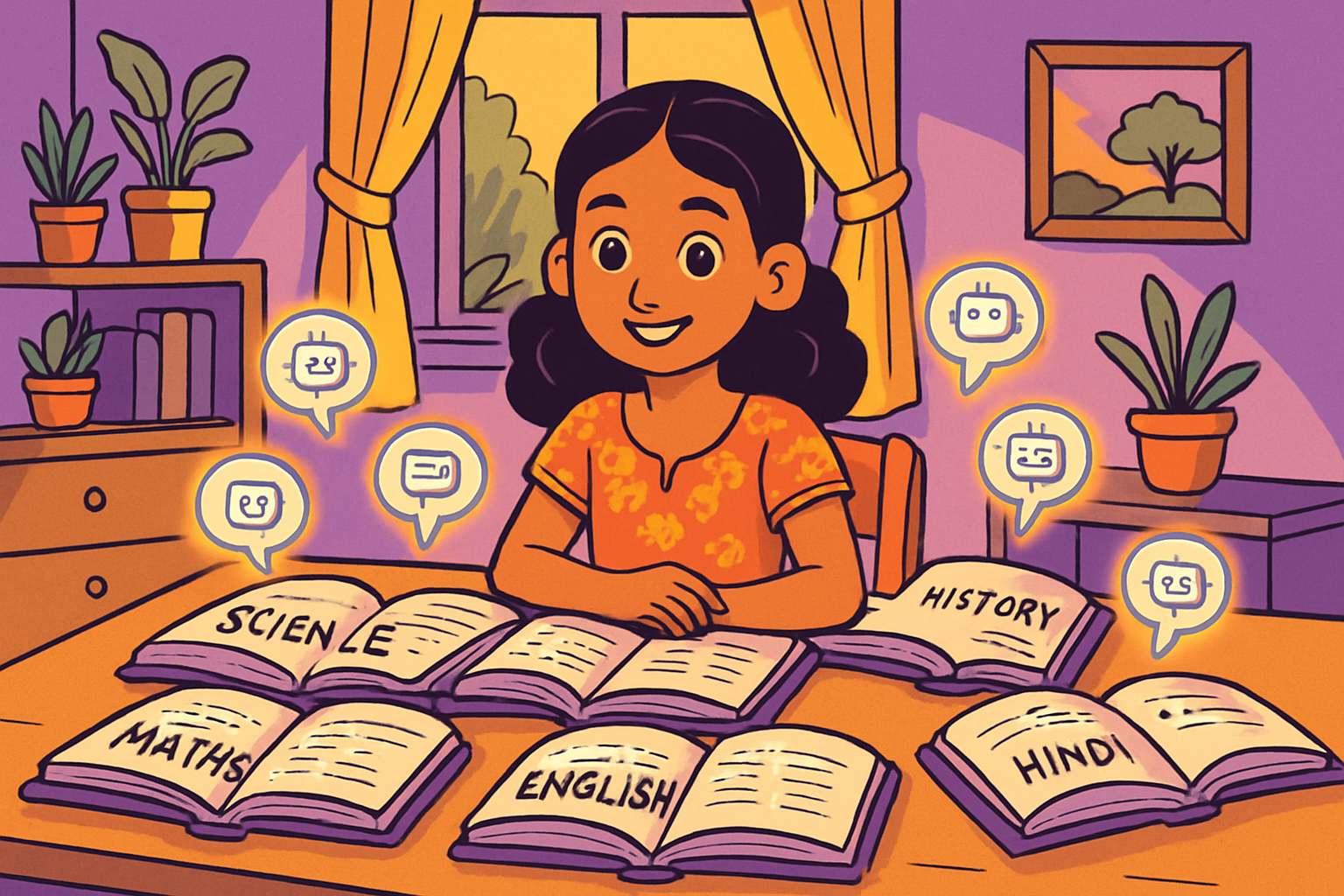
Diya is 12 years old and lives in Bengaluru. She has been in the same class as Arjun for years, but she is much more organised. She keeps a separate notebook for every subject.
One Saturday morning, after finishing Lesson 1 with Arjun, Diya made a decision. "I am going to try AI for every single subject today," she said.
By evening, her notebook had 6 new pages — one for each subject. Some things worked brilliantly. A couple didn't. She wrote down exactly what she learned.
"The trick," she told Arjun on Sunday, "is that different subjects need different kinds of prompts. You can't use the same question for Maths and History."
👉 In this lesson, you will learn exactly what Diya discovered — the best way to use AI for each of your Class 7 subjects.
Section 1 of 8
🗂️ Why Each Subject Needs a Different Approach
In Lesson 1, you learned the basic prompt formula: [What you want] + [Topic] + [Your class level] + [Format].
That formula works for every subject — but what you put inside it changes depending on what you are studying.
🔬
Science
You need clear explanations + real Indian examples + comparisons to what you already know.
📐
Maths
You need concept explanations, not answers. Ask AI to teach, not to solve your homework.
📖
English
You need grammar checks, essay planning, and vocabulary help — not AI-written paragraphs.
🏛️
History / SST
You need timelines, cause-and-effect summaries, and simple explanations of complex events.
🌏
Geography
You need location facts, climate explanations, and connections to modern India and the world.
🗣️
Languages
You need word meanings, grammar rules, and translation checks — not AI-written answers.
One rule for all subjects: Use AI to understand and learn — not to copy and paste. Your final answers must always be in your own words.
Section 2 of 8
🔬 AI for Science — Explain, Example, Connect
Science works best when you can connect a concept to something you have seen in real life. AI is excellent at giving you Indian real-life examples for every science topic.
What to ask AI for in Science:
Simple explanation of a concept in Class 7 language
A real-life Indian example
The difference between two similar things (e.g., plant cell vs animal cell)
Why something happens (cause and effect)
A short summary to revise a chapter
✅ Strong Science Prompt
Explain the water cycle to a Class 7 student in India in 6 bullet points. Use the example of the monsoon season to make it real.
Why it works: mentions class level, asks for bullet points, connects to Indian geography the student already knows.
✅ Another Strong Science Prompt
What is photosynthesis? Explain it using the example of a mango tree. Give me 3 important points to remember for my Class 7 exam.
Why it works: uses a familiar Indian tree, limits the answer to 3 key points, and ties it to exam revision.
Important: If AI gives you a science fact that is different from your textbook — always trust your NCERT or state board textbook for exams. AI can make mistakes with specific details.
Section 3 of 8
📐 AI for Maths — Understand, Not Answer
This is the most important rule for Maths: never ask AI to solve your homework problems. If AI solves the problem for you, you have not learned anything — and you will struggle in your exam.
Instead, use AI to understand the method, so you can solve it yourself.
❌ Wrong way to use AI for Maths
"Solve 3x + 7 = 22"
"Find the area of this triangle: base 8cm, height 5cm"
"Give me all the answers to these 10 problems"
✅ Right way to use AI for Maths
"Explain what a linear equation is with a simple example"
"Walk me through how to calculate the area of a triangle step by step. Don't give me the final answer for my question — just explain the method."
"Why do we flip the fraction when we divide fractions? Can you explain using a real example?"
✅ Strong Maths Learning Prompt
I am a Class 7 student. Explain the concept of percentage to me using examples from Indian daily life — like shopkeeper discounts or cricket scores. Explain the method step by step. Do NOT give me solved answers to homework problems.
Why it works: tells AI exactly what NOT to do, asks for Indian examples, and focuses on understanding the concept.
Diya's method: After AI explains a concept, she closes the chat and tries 2–3 similar problems from her textbook on her own. If she gets stuck, she comes back and asks AI to explain the specific step she missed.
Section 4 of 8
📖 AI for English — Plan, Practise, Polish
English is one of the most useful subjects for AI — but it is also the one where students most easily misuse it. The goal is to become a better English writer yourself, not to have AI write for you.
Three honest uses of AI for English:
1. Grammar and vocabulary help
✅ Grammar Prompt
What is the difference between "will" and "going to" in English? Give me 2 examples of each in everyday Indian conversation.
2. Essay planning (outline only)
✅ Essay Plan Prompt
I need to write a 300-word essay on "Saving Water in India" for Class 7. Give me an outline with 4 sections and one key point for each. I will write the paragraphs myself.
Why it works: clearly says "I will write the paragraphs myself" — AI helps you organise, you do the actual writing.
3. Checking your own writing
✅ Writing Feedback Prompt
I am a Class 7 student in India. Here is a paragraph I wrote. Please find any grammar mistakes and explain what I got wrong. Do NOT rewrite my paragraph — just explain the errors. [Paste your paragraph]
Never do this: Do not ask AI to write your essay, story, or letter for you and then submit it as your own work. This is dishonest, your teacher will likely notice the style is not yours, and more importantly — you learn nothing.
Section 5 of 8
🏛️ AI for History and Social Science — Timelines and Causes
History and Social Science have a lot of facts, dates, and names. AI is excellent at helping you organise this information — but you must always verify important dates and facts with your textbook.
Best uses of AI for History and SST:
Creating a simple timeline of events in order
Explaining why something happened (causes) and what happened as a result (effects)
Summarising a long chapter into 8–10 key points
Comparing two rulers, two time periods, or two events
Explaining a hard concept in simpler language
✅ Strong History Prompt
Explain the main causes of the 1857 Revolt to a Class 7 student in India. Use simple language. Give me 5 causes in bullet points with one sentence explaining each.
✅ Compare and Contrast Prompt
Compare the Mughal Empire and the Maratha Empire in a simple table with 4 rows. Include: time period, key ruler, area they ruled, and one important achievement. Keep it suitable for Class 7 level.
Verify dates and names: AI sometimes gets specific years or the spelling of historical names slightly wrong. Always check important details against your NCERT or state board textbook before writing them in your exam.
Section 6 of 8
🌏 AI for Geography — Maps, Climate, India's Regions
Geography is a subject where understanding "why" is more important than memorising "what". AI is excellent at explaining connections — why a region has a certain climate, why rivers flow in a certain direction, why people in different parts of India live differently.
✅ Climate Prompt
Why does India have a monsoon climate? Explain it to a Class 7 student in 5 sentences. Include the role of the Arabian Sea and the Bay of Bengal.
✅ Region Comparison Prompt
Compare the Thar Desert in Rajasthan and the Western Ghats forests in Kerala. Give me 3 differences in climate, 2 differences in the way people live, and 1 thing they have in common. Keep it at Class 7 level.
AI cannot replace physical maps:
AI cannot draw maps for you — and you should practise drawing and labelling physical maps yourself. Use AI to understand why features exist where they do, then use your atlas or textbook to learn exactly where they are on the map.
Geography tip: When studying rivers, mountains, or states — ask AI for the "connection story". For example: "Why do most major Indian rivers flow eastward and empty into the Bay of Bengal?" Understanding the reason helps you remember the fact.
Section 7 of 8
🗣️ AI for Languages — Hindi, Telugu, and Regional Languages
Most AI tools work very well in English and reasonably well in Hindi. Telugu, Kannada, Tamil, Marathi, and other regional languages are improving but may not be as reliable.
Useful ways to use AI for language subjects:
✅ Word Meaning Prompt (Hindi)
Explain the meaning of the Hindi word "परिश्रम" (parishram) to a Class 7 student. Give me 2 example sentences and explain the difference from the word "काम" (kaam).
✅ Grammar Explanation Prompt
Explain the difference between a simple sentence and a compound sentence in Telugu grammar. Give me one example of each in Telugu and also write the English translation so I can understand.
Important caution for regional languages: AI makes more grammar and vocabulary errors in Telugu, Kannada, and other regional languages than in English. Always check regional language answers with your language teacher or a good dictionary before using them in classwork.
Translation help — use it carefully:
AI can help you understand the meaning of a poem or passage in Hindi or Telugu by translating it into English. But for your exam, you must understand and answer in the required language yourself — do not submit AI-translated answers as your own.
Section 8 of 8
📋 Your Weekly AI Study Routine
The best students don't use AI randomly. They use it as part of a plan. Here is Diya's weekly study routine that you can copy:
📝
Step 1: Read first
Always read your textbook section first. Then use AI to clarify what you did not understand — not as a replacement for reading.
❓
Step 2: Ask specific questions
Ask AI about the specific part you found confusing, not the whole chapter. Specific questions get better answers.
✍️
Step 3: Write in your own words
After reading AI's explanation, close the chat and write a short summary in your own words in your notebook.
✅
Step 4: Verify key facts
Cross-check important dates, names, formulas, and scientific facts with your textbook before writing them anywhere.
🔁
Step 5: Test yourself
Ask AI to give you 5 quick quiz questions on the topic. Try to answer from memory. Then check if you were right.
🙋
Step 6: Ask your teacher
If AI's explanation and your textbook say something different, always ask your teacher. They know your syllabus best.
The triple-check habit: After using AI to understand something, can you (1) explain it in your own words, (2) give an Indian example, and (3) connect it to what you already know? If yes — you have actually learned it!
🧠 Quick Quiz — Test Yourself!
10 questions · Click your answer · Check your score at the end
1. Which is the BEST way to use AI for Maths homework?
2. You are studying photosynthesis. Which prompt will get the best AI answer?
3. Priya copies an AI-written paragraph about the Mughal Empire into her history notebook and submits it as her homework. What is wrong with this?
4. Which subject requires the MOST caution when using AI, because AI makes more mistakes?
5. You are studying the causes of the 1857 Revolt. AI gives a year that is different from your NCERT textbook. What should you do?
6. Diya uses AI to help plan an essay on "Water Conservation in India" for English class. What is the HONEST next step after AI gives her an outline?
7. Which Geography prompt will get the most useful AI answer?
8. For which of these tasks is AI LEAST reliable?
9. What is the "triple-check habit" from Section 8?
10. Why should you always read your textbook FIRST before using AI?
📝 Worksheet — Subject Prompt Practice
Tip: in the print dialog, choose "Save as PDF" to download.
Pick 6 topics — one from each subject you are currently studying. Write one strong AI prompt for each using the formula from Lesson 1. Copy this table into your notebook.
Subject
Current Topic
Your Prompt
Was AI's answer useful? (Yes / Partly / No)
Science
Maths
English
History / SST
Geography
Language (Hindi / Telugu)
Use this table in your notebook today, or print this page directly if helpful.
📋 Note for Parents and Teachers
What this lesson teaches: Students learn to use AI differently for each school subject — with a strong emphasis on using AI to understand and clarify, not to copy. Academic honesty is reinforced throughout every subject section.
What you can do together:
Ask your child to show you the Subject Prompt Worksheet and one real AI conversation they had about a school topic
Discuss the difference between using AI as a study partner vs using AI to do the work for you
For Maths parents: reinforce that AI should never solve problems — only explain the method
For teachers: the triple-check habit (Section 8) can be a regular 5-minute end-of-class activity
Classroom use: The subject-prompt worksheet can be used as a structured homework assignment across any subject area, giving students meaningful AI practice while reinforcing good study habits.