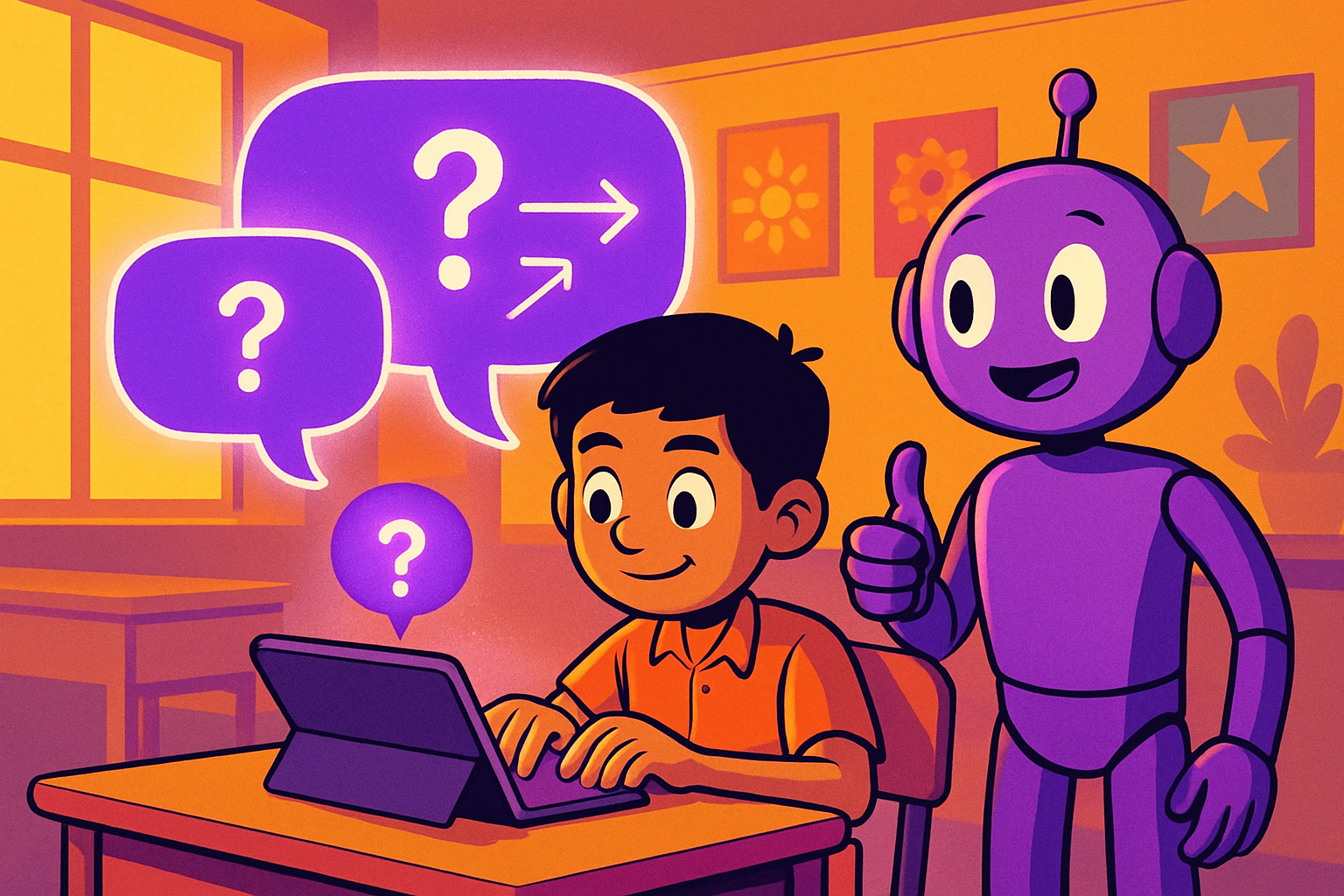
Why Did the AI Give a Confusing Answer? 🤔
Arjun is 12 years old and lives in Warangal. He opened AI and typed: "Explain science."
The AI gave him a 500-word answer about the entire history of science — from Galileo to quantum physics. Arjun stared at the screen. That was not what he wanted at all.
His classmate Diya looked over. "The problem is your question," she said. "AI is like a very obedient assistant. It does exactly what you ask. If your question is vague, the answer will be vague too."
She typed: "Explain photosynthesis to a Class 7 student in 5 simple sentences with one example from daily life."
This time, the answer was clear, short, and perfect for Arjun's revision. Same AI. Different question. Very different result.
That skill — writing a good question for AI — is called prompting. And this whole lesson teaches you how to do it.
📅 Class 7 — Full Year Learning Map
12 lessons · One lesson every 2–3 weeks · Each lesson ≈ 45–60 minutes · All free
💬 What Is a Prompt?
A prompt is the message you type into an AI chatbot. It is your instruction. It is your question. It is how you tell AI what you want.
Think of AI as a very fast, very knowledgeable assistant who does exactly what you say. If your instruction is clear, the result is good. If your instruction is unclear, the result is confusing or useless.
❌ Weak prompt
- Explain science
- Help me with maths
- What is history?
- Tell me about India
✅ Strong prompt
- Explain photosynthesis to a Class 7 student in 5 simple lines
- Give me 3 practice problems on fractions for Class 7
- Summarise the Mughal Empire in 6 bullet points for revision
- List 5 interesting facts about the Indian Constitution for Class 7
🧩 The Simple Prompt Formula
You do not need to memorise anything complicated. Use this simple formula every time you need study help from AI:
Let us see how this works with real examples:
📚 5 Ways to Use AI for Study Help
Now that you know how to write good prompts, here are the best ways to use AI when studying. These are safe, honest, and will actually help you learn.
🔍 When AI Gives a Weak Answer — What to Do
Even with good prompts, AI can sometimes give an answer that is too long, too vague, or simply wrong. Here is how to spot weak answers and fix them.
⚠️ Signs of a weak AI answer
- Too long — paragraphs when you needed bullets
- Too general — about Class 10 when you asked for Class 7
- Facts you cannot find in your textbook
- Answer to a different question than what you asked
- Numbers or dates that seem wrong
✅ How to fix it
- Add "Keep it under 6 sentences" to your prompt
- Add "For a Class 7 student" more clearly
- Always check important facts against your textbook
- Rephrase your prompt and try again
- Ask your teacher if AI and textbook disagree
🛡️ Academic Honesty — The Line You Must Not Cross
Using AI for study help is good and smart. But there is a very clear line between help and cheating. You must know this line and respect it.
✅ Honest use of AI
- Use AI to understand a concept you could not follow
- Use AI to get examples you can study from
- Use AI to practise questions before an exam
- Use AI to get a summary, then write your own notes
- Use AI to simplify a confusing textbook sentence
- Tell your teacher when you used AI for help
❌ Dishonest use of AI
- Copy AI answers directly into your notebook or assignment
- Submit AI-written essays as your own work
- Use AI answers in a class test or exam
- Let AI write your project report without your own thinking
- Hide that you used AI when your teacher asks
🎯 Quick Quiz — Check What You Learned
📝 Worksheet — Write 5 Study Prompts
Tip: in the print dialog, choose "Save as PDF" to download.Choose 5 topics from your current school subjects. Write one good prompt for each using the formula: [What you want] + [Topic] + [Class 7] + [Format]. Copy this table into your notebook.
| # | Subject / Topic | Your Prompt (write it here) | Did AI give a useful answer? (Yes / No / Partly) |
|---|---|---|---|
| 1 | |||
| 2 | |||
| 3 | |||
| 4 | |||
| 5 |
Use this table in your notebook today, or print this page directly if helpful.
📋 Note for Parents and Teachers
What this lesson teaches: Class 7 students learn how to write effective prompts — structured questions that produce useful AI answers. They also learn to identify weak AI answers and practise academic honesty.
What you can do together:
- Ask your child to show you a strong prompt they wrote using the formula from Section 2
- Discuss the difference between honest use (reading + writing in own words) and copying
- Encourage them to use AI for explaining hard concepts in their current school subjects
- For teachers: the worksheet can be assigned as a 15-minute homework task — students write 5 prompts on current syllabus topics
Safety: This lesson reinforces that AI answers must be checked against textbooks. It explicitly teaches that AI can be wrong and that honest use is the right use.