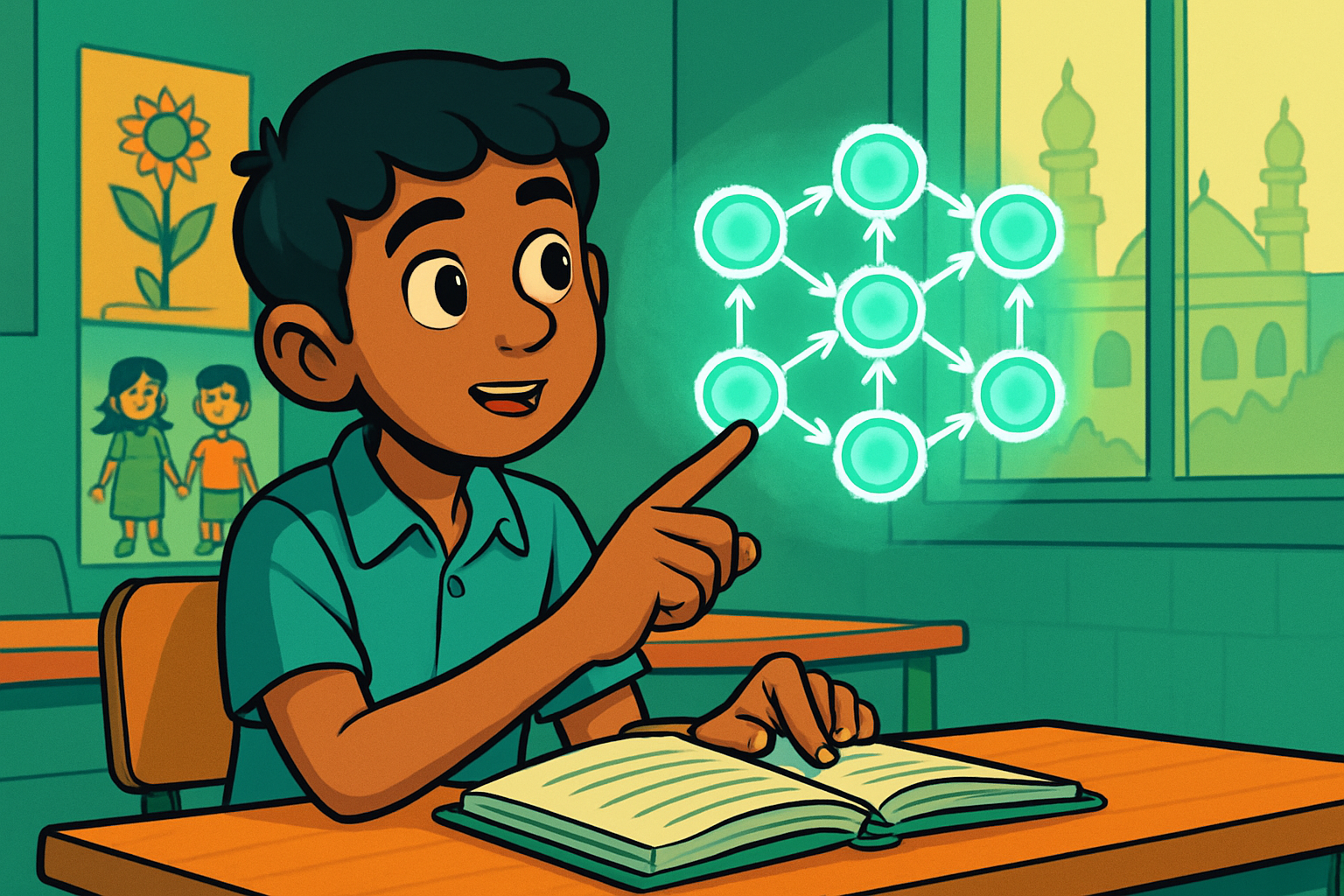
Why Couldn't She Answer? 🤔
Priya, 13, from Visakhapatnam, had been using ChatGPT for a full year of Class 7. She had used it to revise, to write stories, to understand maths problems, and to check her arguments in debates. She was good at it.
Then her Science teacher, Mr Krishnaswamy, asked the class a simple question: "You all use AI every day. Can anyone tell me — how does it actually work? Not what it does. How it works."
Priya opened her mouth — and then closed it. She had used AI dozens of times. But she had no idea what was happening behind the chat window. Was it searching Google? Was it a person typing? Was it memorising answers from a textbook?
She realised she had been using a tool she did not understand at all. She felt the same way she would feel if someone asked her how a mobile phone makes calls — she knew how to use it, but not how it worked.
"That is perfectly normal," said Mr Krishnaswamy, smiling. "Most adults who use AI every day do not know either. But if you want to build with AI one day — or even just use it more wisely — this understanding is important. So let us find out together."
🏗️ Three Nested Ideas: AI, ML, and Deep Learning
People use these three words — AI, machine learning, and deep learning — as if they all mean the same thing. They do not. They are three different ideas, but they are nested inside each other like Russian dolls.
🤖 AI (Artificial Intelligence)
The big umbrella idea: any computer system that can do something that seems intelligent — like recognising speech, recommending videos, playing chess, or translating language.
📊 ML (Machine Learning)
A type of AI where the system learns from examples instead of following fixed rules. Most modern AI is machine learning.
🧠 DL (Deep Learning)
A type of machine learning that uses neural networks with many layers. Used in image recognition, language models, and voice assistants.
A simple example from daily life
Think of a mango sorting machine at a fruit market in Vijayawada. A simple rule-based AI might sort: "if weight is above 200g, label as large." That is AI — but it is not machine learning. It is just a fixed rule.
Now imagine the machine looks at photos of thousands of mangoes, learns which ones are ripe by the colour and texture, and figures out the rule itself. That is machine learning.
Now imagine it looks at thousands of photos and automatically discovers patterns in shapes, edges, colours — using many layers of analysis, like the human visual system. That is deep learning.
📚 How Does Machine Learning Actually Learn?
This is the key question. The answer is simpler than most people think — but it is also surprising.
A machine learning system does not get taught rules. It learns by looking at examples. Thousands or millions of them. Over and over.
🧠 What Is a Neural Network? (Simplified)
Deep learning uses something called a neural network. The name sounds intimidating. The idea is not.
A neural network is a set of connected math calculations arranged in layers. Each layer takes the output of the layer before it and produces a new, more refined output.
The three types of layers
- Input layer: receives the raw data (e.g. pixel values of an image, or words in a sentence)
- Hidden layers: do the actual processing — finding patterns, features, abstractions. A "deep" network has many hidden layers.
- Output layer: produces the result (e.g. "cat" or "dog", or the next word in a sentence)
What are weights?
Every connection between neurons has a number called a weight. Weights determine how strongly one neuron influences the next. During training, these weights are adjusted — this is the "learning" part.
A large language model like GPT has billions of weights. Training it means adjusting all those billions of numbers — using billions of text examples — until it becomes good at predicting language.
🔄 The Training-Testing Split
Here is something important that you will hear again and again in Class 8 and beyond: AI systems are trained on one set of data, but tested on a different set.
| Set | What it is | Purpose |
|---|---|---|
| Training data | The examples the AI learns from — like the textbook it studies | The model adjusts its weights based on these examples |
| Validation data | A set held back during training — used to check progress | Helps decide when to stop training (before the model over-learns the training examples) |
| Test data | Fresh examples the model has never seen — like a surprise exam | Checks whether the model truly learned or just memorised |
Overfitting — the "rote-learning" problem
If a student memorises every answer in the previous year's exam papers but has not truly understood the concepts, they will fail on a new exam. This exact problem exists in AI — it is called overfitting.
An overfit model performs very well on training data but poorly on new data it has never seen. This is why the training-testing split is important — it is how we catch overfitting before deployment.
🌐 Three Types of Learning
Not all machine learning is the same. There are three main types — and understanding which type a system uses helps you understand its strengths and limits.
📐 Why Does AI Need So Much Data?
A common question: why can't AI learn from just a few examples, the way humans do?
A 5-year-old can see two or three cats and recognise every cat they see after that. An AI system typically needs thousands of examples. Why?
- No prior knowledge. A human child has a brain already wired for pattern recognition through evolution. An AI starts with randomly set weights — essentially nothing useful.
- Must cover variation. A cat photo dataset needs cats in different lighting, angles, sizes, breeds, backgrounds, and image qualities — otherwise the system only learns to recognise cats in ideal conditions.
- Statistical confidence. The model needs enough examples to find patterns that are genuinely about cats — not just coincidences in a small sample (like "all photos in bright light are cats").
🏷️ Putting It All Together: The AI Vocabulary Map
Here is the key vocabulary from this lesson, organised clearly:
| Term | Simple definition | Real example |
|---|---|---|
| Artificial Intelligence (AI) | A computer system that does something appearing intelligent | YouTube recommending your next video |
| Machine Learning (ML) | AI that learns from examples instead of fixed rules | Spam filter that learns what spam looks like |
| Deep Learning (DL) | ML using neural networks with many layers | Google Translate, face recognition |
| Neural network | Layers of math calculations inspired by the brain | The structure inside image recognition systems |
| Training data | The examples used to teach the model | Millions of labelled photos used to train an image classifier |
| Weights | Numbers inside the network that get adjusted during learning | GPT has billions of weights |
| Overfitting | When a model memorises training data instead of learning general patterns | A student who rote-learns previous exam answers |
| Supervised learning | Learning from labelled examples | Cat-vs-dog classifier |
| Reinforcement learning | Learning by reward and penalty | AlphaGo playing chess |
💡 What This Means When You Use AI
Understanding how AI learns changes how you use it. Here is what this lesson means in practice:
- AI is not magical — it is patterns from data. If it behaves oddly, there is usually a data or training reason.
- AI is only as good as its training data — if the training data was wrong, biased, or incomplete, the model will be too.
- AI confidence ≠ accuracy — a model that speaks confidently has high-confidence predictions, not necessarily correct ones. Adjust weights that sound authoritative but have not been verified.
- New or rare situations are harder for AI — if your context was rarely in the training data (small Indian town, regional language, unusual topic), AI is more likely to be wrong.
- AI systems are improving constantly — because they are retrained on new data. Something that was wrong last year may be better now — but also, new errors can appear.
🧠 Quiz — Lesson 1
8 questions · Click your answer · Submit for your score
📝 Worksheet — AI, ML, DL in My World
Tip: in the print dialog, choose "Save as PDF" to download.Write your answers in your notebook. Use what you have learned in this lesson.
| Question | My answer |
|---|---|
| Name one AI tool you used in Class 7. Is it based on ML, DL, or a simpler rule-based system? | |
| Describe the 5-step training process in your own words | |
| What is the difference between a model that overfits and one that generalises well? | |
| Name one place where AI is used in your daily life. What type of learning does it likely use? | |
| Why might an AI tool perform worse for a student from a small town in Andhra Pradesh compared to a student from London? |
📋 Note for Parents and Teachers
What this lesson covers: The foundational concepts of how AI actually learns — AI vs ML vs DL, the training process, neural networks, supervised/unsupervised/reinforcement learning, and the training-testing split. No mathematical notation is used — all concepts are explained through analogies and Indian daily-life examples.
Discussion prompts:
- "Can you explain to me, in simple words, what machine learning is and how it is different from a regular computer program?"
- "Why might an AI model that seems very confident still be wrong?"
- "If you were building an AI to recognise mango varieties — what training data would you need?"
What comes next: Lesson 2 goes deeper into data — the fuel that makes AI work. Students will learn what a dataset actually looks like, what clean vs messy data is, and why the quality of training data matters more than the sophistication of the model.