No sign-in needed · English narration · Safe for all school ages
Story · One Year Later
From "What is AI?" to "I Built Something" 🌟
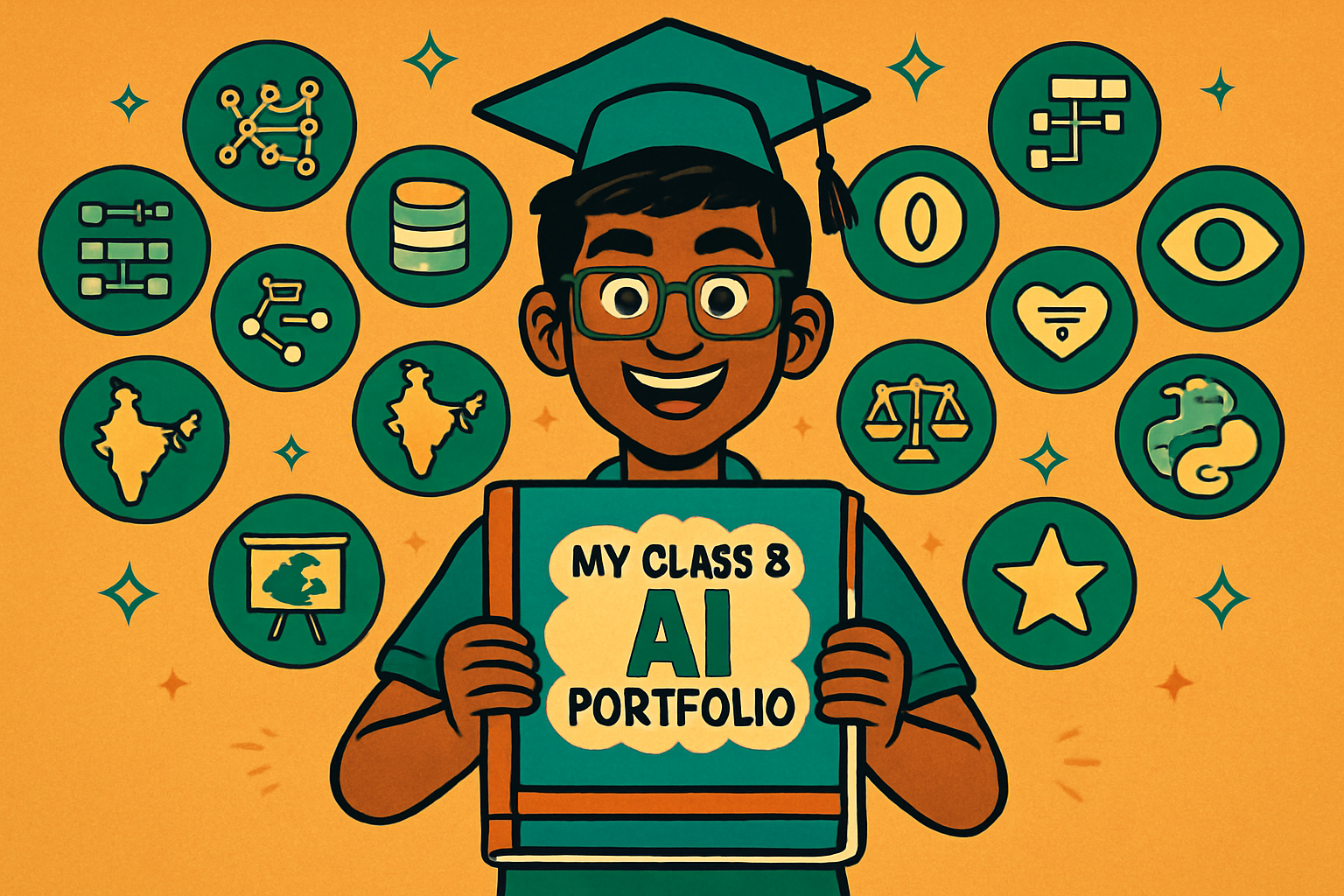
When Priya started Class 8, she knew AI as something that autocorrected her messages and recommended videos. By Lesson 12, she had learned how neural networks actually learn from data, why AI systems can be unfair, how India is using AI in healthcare and farming, how to write Python code, and how to build a real project that someone would actually use.
"Do you feel like you understand AI now?" her teacher asked. "I understand it well enough to use it, question it, and build things with it," Priya said. "And I know that's not everything — but it's a start."
Her teacher nodded. "That's more than most adults know."
👉 In this lesson: recap all 12 lessons, check off your skills, build your AI portfolio, print your certificate, and preview Class 9.
Section 1 of 6
🗂️ Your Class 8 Journey: All 12 Lessons
Lesson 1
How Does AI Really Work?
Pattern recognition + training data, not magic
Lesson 2
Data: The Ingredient AI Needs
Structured vs unstructured, data quality, consent
Lesson 3
How AI Learns: Classification and Prediction
Supervised learning, overfitting, testing sets
Lesson 4
Building AI Workflows
7-step project process, edge cases, deployment
Lesson 5
How Language Models Work
Tokens, probabilities, hallucinations, prompting
Lesson 6
Computer Vision: How AI Sees
Pixels as numbers, convolution, Indian CV applications
Lesson 7
AI Bias and Fairness
4 types of bias, real examples, what individuals can do
Lesson 8
AI Ethics and Society
5 big questions, trolley problem, AI regulation
Lesson 9
AI in India: Real Innovation
Healthcare, agriculture, language, education, space
Lesson 10
AI for Your Own Projects
6-step framework, 5 project templates, common mistakes
Lesson 11
Python Basics
Variables, lists, if/else, for loops, study plan generator
Lesson 12
My Class 8 AI Portfolio
You are here — recap, portfolio, certificate, Class 9 preview
Section 2 of 6
✅ Skills Checklist — Tick What You Can Do
Click each skill to mark it complete. Be honest — this is for your own reflection.
I can explain how AI learns from training data using a real example
I can tell the difference between structured and unstructured data
I can describe what "classification" means in machine learning
I can name the 7 steps of building an AI workflow
I understand why AI language models can hallucinate (make things up)
I can explain how computer vision converts pixels into decisions
I can identify at least 2 types of AI bias and give an example of each
I can discuss an AI ethics question and name at least 2 stakeholders affected
I can name 3 real Indian AI applications and what problem each solves
I can define a problem clearly enough to plan an AI project around it
I can write and run a Python program in Google Colab
I have at least one piece of work (prompt, project, output, or reflection) I am proud of from this class
0 / 12 skills checked
Section 3 of 6
📁 Build Your Portfolio: What to Include
A portfolio is a curated collection of your best work. It shows what you can do, not just what you know. Here is what to include in your Class 8 AI portfolio:
💬
Your Best Prompt
Choose one AI prompt you wrote that got a genuinely useful result. Write it out with the full response. Add a short note: what did you ask, why did it work, what would you improve?
📄
A Study Output You Used
A summary, question set, or explanation you generated with AI and actually used for studying. Annotate it: which parts were accurate, which needed correction, what you learned from that.
🛠️
A Project or Program
Either your project plan from Lesson 10 (fully written up with problem statement, tool choice, and small version plan) or your Python study plan generator from Lesson 11 (with your personalised subjects).
🔍
A Moment I Caught Bias
Describe one time you noticed AI being unfair or wrong during this class — or in daily life after starting Class 8. What was the bias? Who was affected? What would fix it?
✍️
My Reflection
Write 100–150 words: What did you think AI was before Class 8? What do you think now? What is one thing you want to learn more about in Class 9?
Section 4 of 6
🎤 3-Minute Presentation Guide
If your teacher asks you to present your portfolio to the class, use this structure:
0:00–0:30
Start with your story: "When I started Class 8, I thought AI was..." and end with "Now I know that..."
0:30–1:00
Show your best work: "The piece of work I am most proud of is this [prompt / project / program] because..."
1:00–1:30
Share a surprise: "The most surprising thing I learned was..." (AI bias examples, hallucinations, Indian AI applications — anything that genuinely changed how you think)
1:30–2:15
Raise a question: "One thing I am still wondering about is..." — this shows intellectual honesty and curiosity, which teachers value more than pretending to know everything
2:15–3:00
What next: "In Class 9, I want to learn about [topic]" and invite one question from the class
Section 5 of 6
🔮 Class 9 Preview: What Comes Next
Class 9 goes deeper into building and evaluating AI systems. Here is a preview:
Class 9 · L1
Neural Network Internals
Layers, weights, activation functions — how a neural network actually updates itself
Class 9 · L2
Building a Classifier in Python
Write a real ML classifier using scikit-learn in Colab — beyond study plan generators
Class 9 · L3
Model Evaluation Metrics
Accuracy, precision, recall, F1 — how to actually measure if an AI model is good
Class 9 · L4
Generative AI: How It Creates
Diffusion models, GANs, transformers — how AI generates images, music, and text
Class 9 · L5
AI in the Workplace
Which jobs will change, which skills will grow, and how to prepare for an AI-integrated career
Class 9 · L6
Building Your First API-Connected Tool
Call a real AI API from Python — build a tool that talks to ChatGPT or Gemini programmatically
Section 6 of 6
🧠 What Makes a Good Class 8 AI Learner?
A weak learner says...
A strong Class 8 AI learner says...
"AI is magic — I don't need to understand how it works."
"AI is pattern recognition on training data. I understand the basics of how it learns."
"Whatever AI says is true."
"AI can hallucinate. I always check important facts against other sources."
"AI is just a tool — it can't be biased."
"AI reflects the data it was trained on. Biased data produces biased systems. I check for this."
"AI will take all jobs."
"AI will change many jobs. The people who understand it have an advantage."
"I just use AI. I don't need to know how it works."
"Understanding how it works makes me a better user, a better critical thinker, and a future builder."
"I have no projects to show — just quiz scores."
"I have a portfolio: a prompt I wrote, a project I planned, a program I ran, and a reflection I am proud of."
🏆 Final Quiz — Class 8 Capstone
10 cross-lesson questions · Click your answer · Submit for your final score
1. AI learns by finding patterns in training data. What does this mean in practice?
2. Why is data quality more important than data quantity for training AI systems?
3. A language model sometimes states incorrect facts with full confidence. This phenomenon is called:
4. In computer vision, what does the model actually receive as input when it "looks" at an image?
5. Historical bias in an AI system occurs when:
6. Bhashini is a major Indian government AI project. What is its primary purpose?
7. The most important first step when planning any AI project is:
8. In Python, for subject in subjects: is a for loop. What does it do?
9. A good AI portfolio contains evidence of your learning. Which of the following is the BEST portfolio item?
10. Which statement best describes the right relationship between AI and a thoughtful Class 8 student?
🏅 Print Your Completion Certificate
Enter your name below, then click Print Certificate to save or print it.
🌿 Mitra AI Life Education
Certificate of Completion
This certifies that
Your Name Here
has successfully completed
Class 8 — Understanding AI Deeply
12 lessons · AI concepts, ethics, bias, India AI, Python basics