Class 6 · Age 10–11 · AI for Students · Lesson 11 of 12
AI Careers in India
What jobs will exist when you grow up? Discover the careers AI is creating, which jobs AI helps, what skills always matter, and how to start preparing right now.
Read all 8 sections below while we prepare the video.
📖 Meet Meera
Career Day and the Big Question
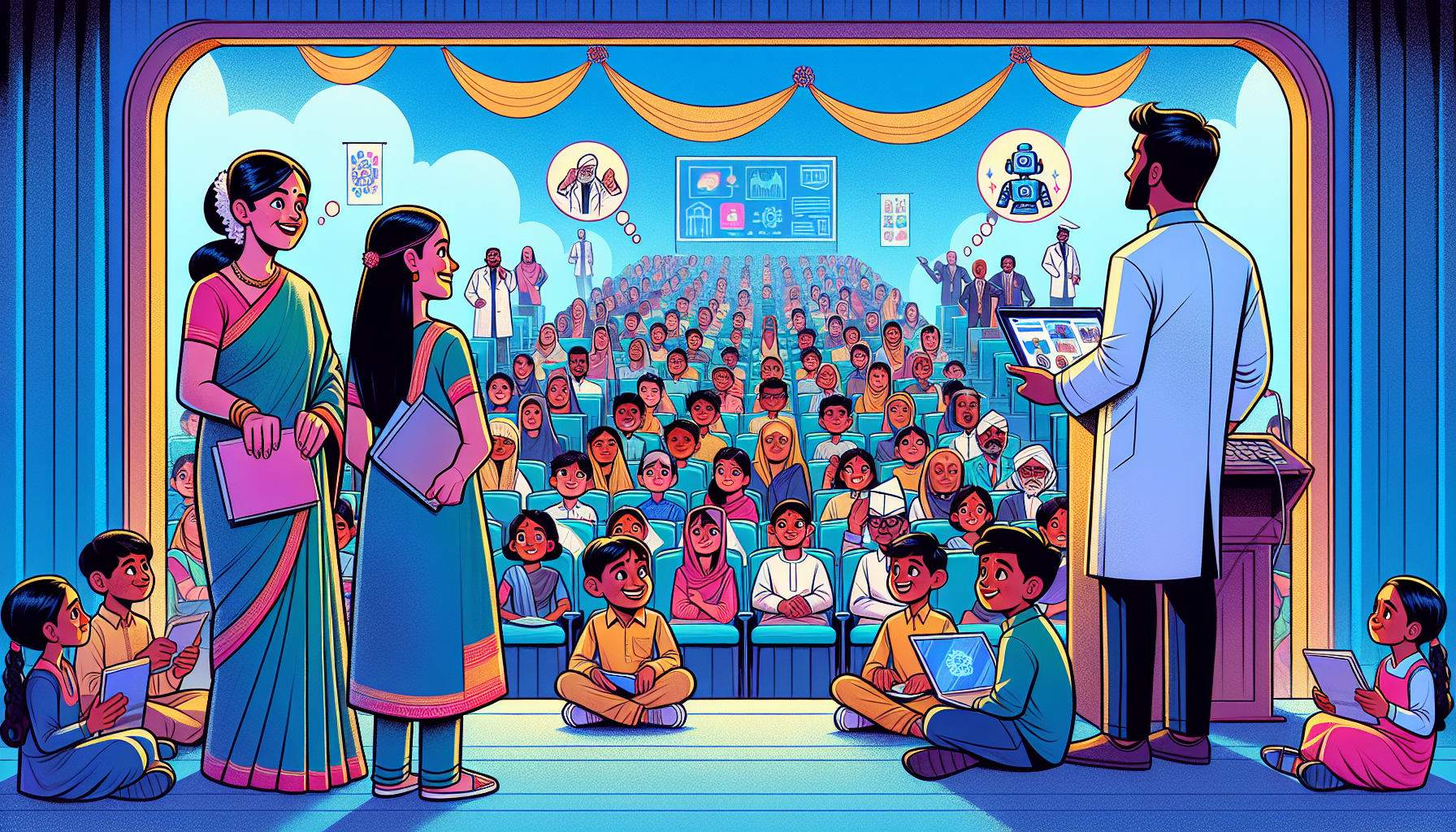
Meera is 11 years old and lives in Chennai, Tamil Nadu. Her school holds a Career Day every year where professionals come and speak. This year, the guests included a doctor, an engineer, a teacher, a journalist, and — new this year — an AI developer from a tech company in Chennai's IT corridor.
The AI developer, Mr. Rajan, said something that Meera could not stop thinking about: "Most of the specific jobs I do today didn't exist ten years ago. And many of the jobs you will have when you are 25 don't exist yet."
On the way home, Meera asked her uncle — who works as a software engineer in the same IT corridor — "Does that mean all other jobs will disappear? Will AI take every job? Should I even bother studying?"
Her uncle smiled. "That's not how it works," he said. "AI doesn't replace people — it changes what people do. The doctor is still a doctor. The teacher is still a teacher. But they use AI tools now. And there are brand new jobs that didn't exist before. Your generation will have more interesting careers than any generation before you — if you prepare well."
That evening, Meera and her uncle spent two hours exploring what AI careers look like in India right now, which jobs AI helps rather than replaces, and — most importantly — what she should focus on in school to be ready for whatever comes next.
🚀 This lesson explores the real landscape of AI careers in India — what jobs exist, what new ones are emerging, which skills are becoming essential, and what you can start doing right now in Class 6 to prepare.
Section 1 of 8
🔄 Jobs Are Changing — Not Disappearing
Every major technology in history changed jobs — it didn't eliminate the need for human work. The printing press changed how books were made. Electricity changed factories. The internet changed business. AI is the next major shift. Here is how to understand it:
Technology shift
Jobs that changed
Jobs that were created
Printing press (1400s)
Scribes (who copied books by hand) became less needed
Printers, publishers, editors, authors — millions of new roles over centuries
Software developers, web designers, digital marketers, data analysts — vast new industries
AI (now and coming)
Routine, repetitive tasks in many jobs are being automated
AI developers, data scientists, prompt engineers, AI trainers, AI ethicists, AI teachers — and many more
The pattern: Technology removes some tasks from jobs — usually the most repetitive ones. But it creates new tasks, new roles, and entirely new industries. The total number of jobs has grown with every technology shift in history. AI is expected to follow the same pattern — the key question is which skills you develop.
In India specifically, the AI sector is growing rapidly. The National Association of Software and Service Companies (NASSCOM) estimates India needs millions of AI-skilled professionals over the next decade. India already produces one of the largest numbers of engineering graduates in the world — the opportunity is enormous for this generation.
Section 2 of 8
💼 AI Jobs in India Right Now
Here are real AI career roles that exist today in India — with what they actually do and approximate starting salaries at major companies:
📊
Data Scientist
₹8–25 LPA starting
Analyses large datasets using statistics and AI tools to find patterns. Helps businesses make better decisions. Heavy maths and Python programming required.
🤖
ML Engineer
₹10–30 LPA starting
Machine Learning Engineer — builds and trains the AI models themselves. Requires deep knowledge of maths, statistics, and programming.
💬
Prompt Engineer
₹5–18 LPA starting
Designs and refines prompts to get the best outputs from AI systems. Requires strong language skills, logical thinking, and deep understanding of how AI responds.
🏷️
AI Trainer / Data Annotator
₹3–8 LPA starting
Labels, classifies, and evaluates AI training data — teaching AI what is correct. An important entry-level role; India has a large data annotation industry.
⚖️
AI Ethics Researcher
₹8–20 LPA starting
Examines the fairness, safety, and social impact of AI systems. Ensures AI doesn't harm communities or create unjust outcomes. Combines technical and social science knowledge.
🎯
AI Product Manager
₹12–35 LPA starting
Defines what AI products should do, how they should work, and who they serve. Bridges the gap between technical teams and business needs. Communication skills are critical.
🎨
AI UX Designer
₹7–20 LPA starting
Designs how people interact with AI systems — making them easy, clear, and safe to use. Combines design skills with understanding of how AI works.
🏥
AI in Healthcare Specialist
₹8–25 LPA starting
Applies AI to medical imaging, diagnosis assistance, patient data, and drug discovery. Combines medical knowledge with AI tools — a rapidly growing field in India.
Note on salaries: These are approximate ranges as of 2025–26 for roles at established Indian tech companies and startups. Actual salaries vary widely based on company, city, experience, and skills. The ranges are shown to give you a realistic picture — not to imply these are guaranteed. LPA = Lakhs Per Annum.
Section 3 of 8
🤝 Jobs That AI Helps — Not Replaces
One of the most important things to understand is that AI makes most professionals better at their jobs — it doesn't make the job disappear. Here are real examples from across Indian professions:
🩺
Doctor
AI helps with: Reading medical scans and X-rays, flagging unusual patterns in test results, suggesting diagnoses, personalising treatment plans
Human still does: Patient communication, ethical decisions, surgery, empathy and care, clinical judgment
👩🏫
Teacher
AI helps with: Personalising learning pace, creating practice questions, tracking student progress, translating content
Human still does: Mentoring, inspiring students, understanding emotional needs, classroom relationships
⚖️
Lawyer
AI helps with: Searching case law, summarising legal documents, drafting standard contracts, flagging relevant precedents
Human still does: Courtroom arguments, client relationships, strategy, ethical judgment, novel legal situations
🌾
Farmer
AI helps with: Soil analysis, crop disease detection from photos, weather-based irrigation recommendations, market price predictions
Human still does: Farming decisions, land management, community knowledge, adapting to local conditions
📰
Journalist
AI helps with: Fact-checking tools, transcription, initial research, translating international news
Human still does: Investigation, source relationships, editorial judgment, ethics, original reporting
Human still does: Site decisions, safety accountability, community engagement, creative problem-solving
The pattern across all professions: AI handles the information-heavy, pattern-matching, and repetitive tasks within a job. The human focuses on judgment, relationships, creativity, and accountability. The jobs don't disappear — they become more interesting for the humans doing them.
Section 4 of 8
🏢 India's AI Industry — Cities and Companies
India is one of the world's top AI talent destinations. Here is where the industry is concentrated and which companies are leading it:
City / Region
AI industry presence
Notable companies / institutions
Bengaluru
India's largest tech hub — "Silicon Valley of India." Highest concentration of AI companies and talent.
Infosys AI, Wipro AI, Flipkart AI, Swiggy, CRED, many global AI company India offices (Google, Microsoft, Amazon)
Hyderabad
Major AI and pharma-tech hub. Strong in AI for healthcare and financial services.
Microsoft India Development Centre, Google Hyderabad, Cyient, many biotech AI startups
Mumbai
Fintech and AI-for-finance capital. Strong media and entertainment AI presence.
Tata Consultancy Services, Reliance Jio AI, HDFC Bank AI, Zepto, many fintech startups
Chennai
Growing AI hub, strong in automotive AI and manufacturing AI. Also a major data centre location.
Ford India AI, Zoho, Freshworks, Cognizant Chennai, TVS AI research
Pune
Fast-growing tech hub, strong in engineering AI and enterprise software.
Bajaj Auto AI, many global tech company engineering centres
Delhi / Gurgaon / Noida
Major hub for AI in government services, edtech, and healthcare.
Paytm, IndiaMart, many edtech AI companies (BYJU's, upGrad), government AI initiatives
🇮🇳 Made in India — AI Success Stories
Zoho Corporation (Chennai) — Indian-founded software company now building AI tools used globally by millions. All R&D done in India.
Freshworks (Chennai) — Customer service AI platform, listed on US stock exchange, founded and built in India.
Ola / Ola Electric — Using AI for route optimisation, battery management, and autonomous vehicle research.
ISRO — India's Space Research Organisation uses AI for satellite image analysis, mission planning, and data processing from Chandrayaan and Mangalyaan missions.
Section 5 of 8
🌟 Skills That Will Always Matter
Here is the most reassuring thing about the future of work: certain human skills are becoming more valuable as AI becomes more powerful — not less. These are skills AI cannot genuinely replicate.
🧠
Critical Thinking
Evaluating information, questioning assumptions, spotting errors — like we practised in Lesson 10. AI produces output; humans judge whether it is correct and useful.
❤️
Empathy
Understanding and genuinely caring about other people's feelings and needs. No AI can authentically empathise. Doctors, teachers, counsellors — all need deep empathy.
🎨
Original Creativity
Ideas rooted in real experience, cultural depth, and personal insight — like we explored in Lesson 9. AI remixes patterns; humans create from meaning.
🤝
Communication
Explaining complex ideas clearly, listening well, persuading, negotiating, building trust. The ability to work effectively with other humans in complex situations.
⚖️
Ethical Judgment
Knowing right from wrong in complex, ambiguous situations. AI can flag dilemmas but humans must make the ethical decisions — especially in healthcare, law, and governance.
🔧
Adaptability
Learning new tools, changing with new situations, recovering from setbacks. The world will keep changing — people who can adapt quickly will always be valuable.
💻
AI Literacy
Understanding what AI can and can't do, how to use it effectively, and when to trust it — everything you are learning in this course. Becoming essential in every field.
📐
Maths & Logic
The foundation of all AI work. Data science, machine learning, and AI product management all require strong mathematical thinking.
🌐
English Communication
Most AI tools work best in English. Strong English reading, writing, and speaking skills give you access to global opportunities in AI-related work.
Good news for Class 6 students: The "always matter" skills — critical thinking, empathy, communication, ethical judgment — are exactly what your regular school curriculum builds. Every subject you study contributes to your AI-era readiness. There is no special track you need to be on right now. Do well in all subjects, develop curiosity, and you are already preparing.
Section 6 of 8
📚 How to Prepare Now — A Class 6 Roadmap
You don't need to make career decisions at age 11. But there are habits and foundations you can build now that will serve any AI-era career path. Here is what Meera's uncle recommended:
Now (Class 6–8)
Foundations
Maths · Science · English · Curiosity. Use AI tools. Ask questions. Read widely. Build the fact-checking habit from Lesson 10.
Class 9–10
Exploration
Computer Science if available. Online free courses. Build small projects. Discover what interests you — coding, design, writing, science, medicine.
Class 11–12
Direction
Choose a stream that excites you. Science + Maths for AI/engineering. Humanities for AI ethics, policy, and product roles. Any stream benefits from AI literacy.
College
Specialisation
CS, Data Science, AI degree options now exist at IITs, NITs, and many colleges. Free online learning (Coursera, NPTEL) can supplement any degree.
Career
Lifelong Learning
AI changes fast. The professionals who succeed long-term are those who keep learning throughout their careers — not just in school.
Specific things to do right now (Class 6 level):
Use AI tools like Gemini or ChatGPT to help with learning — but always verify, as you learned in Lesson 10
Ask "how does this work?" about technology you use every day — your phone, apps, recommendations
Try one free online logic or coding activity (Code.org has free beginner activities)
Read at least one non-fiction book this year about science, technology, or how things work
Practice explaining things clearly to others — communication is a skill you build through use
Take your Maths and Science seriously — they are the foundation of the most interesting AI career paths
Free learning resources for Indian students: NPTEL (nptel.ac.in) — free university-level courses in English and regional languages. Code.org — free beginner coding. Khan Academy — free maths and science at all levels. Coursera and edX offer free audit access to global university courses. You can start exploring any of these right now, at your own pace.
Section 7 of 8
🌟 Indian Role Models in AI
Here are real Indian scientists, engineers, and leaders who are shaping the AI industry — showing that this is a field where Indians are not just participants but global leaders:
Sundar Pichai
CEO, Google / Alphabet
Born in Madurai, Tamil Nadu. Leads one of the world's most influential AI organisations — Gemini, Google Search AI, DeepMind, and more. Studied at IIT Kharagpur before going to the US.
Satya Nadella
CEO, Microsoft
Born in Hyderabad, Telangana. Led Microsoft's transformation into an AI-first company and its ₹90,000+ crore investment in OpenAI. Studied at Manipal Institute of Technology.
Fei-Fei Li
Stanford AI Lab / Google Cloud
While not Indian, she is a key figure in AI. Mentioned here because she led ImageNet — the training dataset that enabled modern computer vision — which powers many Indian AI applications.
Sridhar Vembu
Founder & CEO, Zoho Corporation
Built a global software company entirely from Chennai with zero outside investment. Now leading AI initiatives from rural Tamil Nadu — proving world-class AI work can be done from anywhere in India.
Girish Mathrubootham
Founder, Freshworks
Founded one of India's first software companies to list on a US stock exchange. Freshworks uses AI to power customer service tools used by millions worldwide — built and headquartered in Chennai.
Dr. Tessy Thomas
DRDO / India's Missile Programme
Known as India's "Missile Woman." Led the Agni-IV missile project — which uses AI and advanced control systems. A role model for Indian women in technology and defence research.
The key insight from these role models: They come from Tamil Nadu, Telangana, Kerala, rural India — not just from one city or one background. They studied at Indian universities before going on to global roles — or built global companies from India without leaving. Your location and background are not limitations. Your curiosity and work ethic are the deciding factors.
Section 8 of 8
🗺️ Your AI Career Path — How It Could Look
There is no single path into an AI career. Here are three very different routes — all starting from Class 6 in India — to show you the range of possibilities:
Maths + Science (for medicine/engineering) or any stream (for law, social science)
MBBS, BVSc, LLB, B.Ed, B.Agri — then specialise with AI tools in your field
AI-assisted doctor, AgriTech AI specialist, Legal AI analyst, EdTech AI curriculum designer
AI + Creative / Humanities
Writing, design, policy, ethics, language, media
English + any subjects you love. Build communication and critical thinking.
Mass Communication, Design, Political Science, Economics, Linguistics
AI Ethics Researcher, Prompt Engineer, AI Content Strategist, AI Policy Analyst, AI UX Designer
Important: These routes are not fixed tracks. Many successful AI professionals have crossed between them. A journalist who learns to use AI tools becomes an AI media specialist. A doctor who learns data science becomes a health AI specialist. The combination of domain knowledge + AI skills is often more valuable than pure AI skills alone.
For Class 6, the message is simple: do not close any doors. Focus on being curious, building strong foundations in all subjects, and developing the habits this course has taught you. The specific career will emerge as you discover what you love — probably in subjects and fields that don't exist yet in exactly this form.
Meera's plan after Career Day: She decided to focus on maths (which she already enjoys), try Code.org's free beginner coding modules, and start using Gemini to help with her Social Science research — practising the fact-checking skills from Lesson 10 every time. She didn't decide on a career. She just decided to stay curious and keep the options open.
🧠 Lesson 11 Quiz — 10 Questions
1. Based on historical patterns, what happens to total employment when major new technology arrives?
2. What does a Data Scientist primarily do?
3. Which Indian city is most associated with the country's tech and AI industry — often called "India's Silicon Valley"?
4. What is a "Prompt Engineer"?
5. In the AI + professions relationship described in this lesson, what part of a doctor's job does AI MOST help with?
6. Which of these skills is described as becoming MORE valuable as AI becomes more powerful — because AI cannot genuinely replicate it?
7. Sridhar Vembu built Zoho Corporation — a globally used software company — from which Indian city without outside investment?
8. What is the BEST thing a Class 6 student can do right now to prepare for AI-influenced careers?
9. What does an "AI Ethics Researcher" do?
10. Which statement BEST describes what a student interested in medicine should do to prepare for an AI-influenced medical career?
0/10
Your Score
📝 Worksheet — My AI Career Exploration
Tip: in the print dialog, choose "Save as PDF" to download.
Interview someone you know who works — a parent, neighbour, teacher, or relative. Ask them the 5 questions below. Then complete the reflection section on how AI might affect their work.
Person I interviewed: _______________________ Their job: _______________________
Question
Their answer
1. What are the most repetitive tasks in your job — things you do the same way every time?
2. What part of your job requires the most human judgment and care?
3. Do you already use any AI or digital tools at work? What do they do?
4. What skill has been most useful in your career that you wish you'd learned earlier?
5. What advice would you give a Class 6 student about preparing for the future of work?
My reflection: Based on their answers and this lesson, which parts of their job could AI help with? Which parts will always need a human? Write 3–5 sentences:
Bonus: If you could combine your favourite school subject with AI to create a career, what would it be? Give it a name and describe what you'd do in 2–3 sentences.
Keep this worksheet. In 5 years, look back at it — you may be surprised how your career thinking has evolved.
👨👩👧 Note for Parents and Teachers
This lesson introduces Class 6 students to India's AI career landscape — grounding the "AI will take all jobs" fear with evidence-based understanding of how technology historically changes rather than eliminates work, what AI careers actually exist in India now, and what skills genuinely matter for the future.
What your child learned today:
How technology has historically changed jobs — always creating more than it eliminated
Eight real AI career roles in India with approximate salary ranges and required skills
How AI helps rather than replaces doctors, teachers, lawyers, farmers, journalists, and engineers
India's AI industry geography — Bengaluru, Hyderabad, Mumbai, Chennai, Pune, Delhi
A Class 6-level career preparation roadmap: foundations now, exploration in Class 9–10, direction in Class 11–12
Indian role models: Sundar Pichai, Satya Nadella, Sridhar Vembu, Girish Mathrubootham, Dr. Tessy Thomas
Three career routes into AI (Technical, AI+Domain, AI+Humanities) — showing that any interest area connects to AI
How to support at home:
Ask your child to show you the career interview worksheet and discuss their answers together
Share what AI tools or digital technology you use in your own work — children learn career relevance from real family examples
Encourage curiosity over premature specialisation — Class 6 is far too early to fix on a single career path
Explore free learning resources together: NPTEL, Code.org, or Khan Academy — all are free and India-accessible
For teachers: The career interview worksheet makes an excellent real-world connection assignment — students practise structured interviewing, information gathering, and synthesis skills alongside career literacy. The "combine your favourite subject with AI" bonus question often produces surprisingly creative and thoughtful career concepts that reveal students' genuine interests.