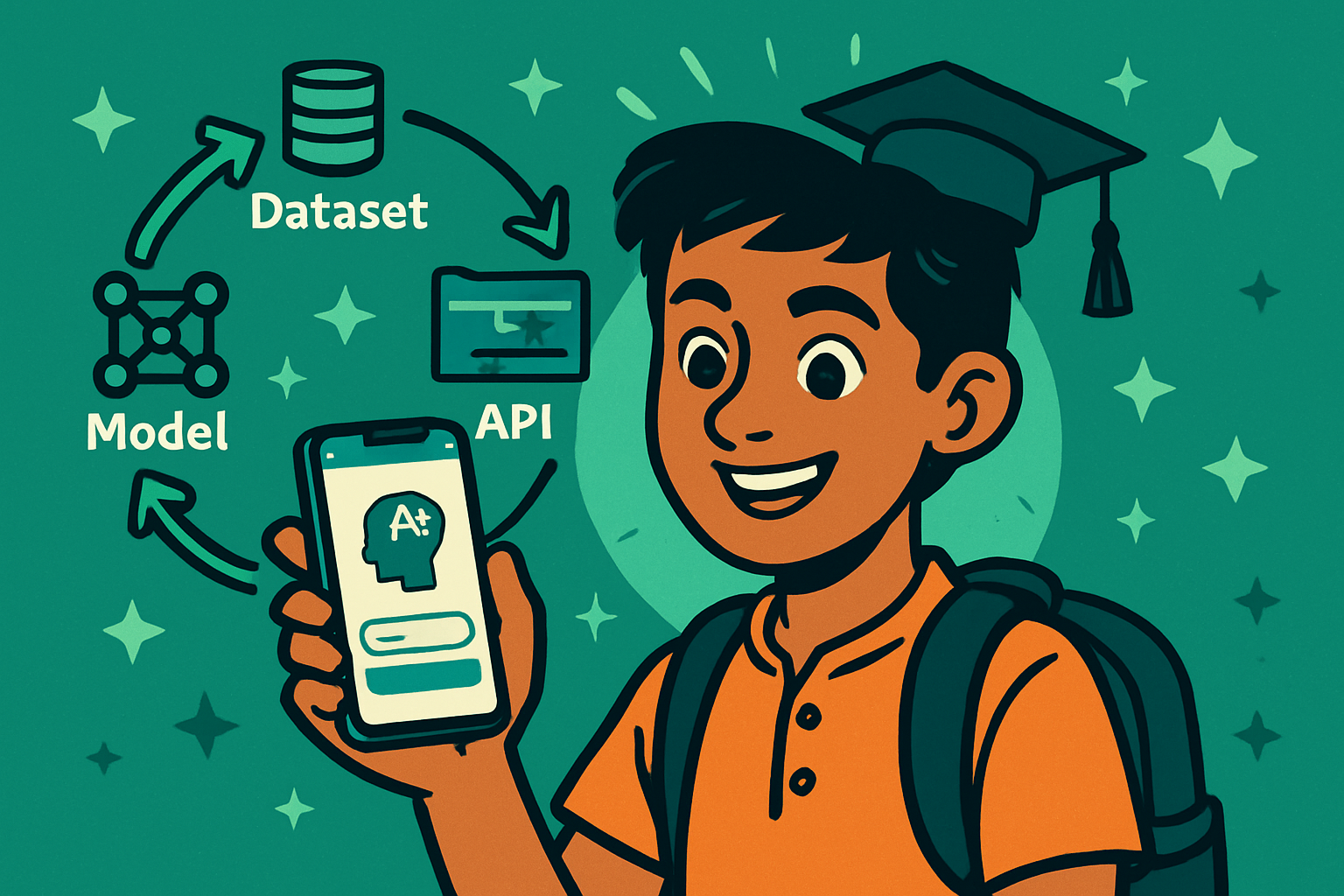
12-Lesson Journey
Everyone You Met Along the Way
Lesson 01
Convolutional Neural Networks
🌾 Meera, Delhi — Mango disease CNN
Lesson 02
Transfer Learning
🌸 Kiran, Bengaluru — Karnataka flower classifier
Lesson 03
Object Detection: YOLO
🚗 Aditya, Chennai — Traffic monitoring
Lesson 04
Transformers and Attention
✍️ Zara, Srinagar — Kashmiri poetry translation
Lesson 05
Fine-Tuning Language Models
🛍️ Rahul, Kolkata — Hinglish review sentiment
Lesson 06
RAG Chatbot
💊 Priya, Chandigarh — Medical PDF Q&A
Lesson 07
ML Pipelines + MLflow
📊 Arjun, Indore — Experiment tracking
Lesson 08
FastAPI Model Serving
⚡ Sneha, Vadodara — Loan prediction API
Lesson 09
Streamlit AI Web Apps
🌿 Dev, Kochi — Plant disease web app
Lesson 10
AI for Real Indian Problems
🇮🇳 Kavita, Bhopal — Soybean disease detector
Lesson 11
Responsible AI at Scale
⚖️ Amar, Vizag — Loan fairness audit
Lesson 12
Capstone
🏆 You — Your AI Product!
Wisdom from Each Lesson
One Key Insight per Lesson
| Lesson | Key Insight |
|---|---|
| L01 CNNs | Filters learn to detect features — edges, textures, shapes — automatically. You don't hand-code them; the network discovers them by gradient descent. |
| L02 Transfer Learning | Never train from scratch when a pretrained model exists. Freeze the base, train only the head — you get ImageNet's years of training for free. |
| L03 YOLO | IoU and NMS are what make detection practical — without them, every model produces overlapping garbage boxes that mean nothing. |
| L04 Transformers | Attention = learnable, weighted focus. The model learns which words to pay attention to for each word. That's the whole revolution. |
| L05 Fine-Tuning | IndicBERT + your labelled data is more powerful than GPT-4 zero-shot for Indian language classification. Domain data beats model size. |
| L06 RAG | Grounding = giving the LLM the exact text to answer from. Without it, LLMs confabulate. With it, they cite. |
| L07 MLflow | If you can't reproduce your best run, it doesn't exist. Log everything from day one. |
| L08 FastAPI | A model not accessible via API is a model no one else can use. 50 lines of Python changes that. |
| L09 Streamlit | The fastest path from model to shareable demo is a Python script and a free URL. No HTML required. |
| L10 AI for India | The most impactful AI isn't the most sophisticated. It's the most useful for the most underserved people. |
| L11 Responsible AI | 84% overall accuracy can hide 31% FPR for rural groups. Always audit by subgroup before deploying systems that affect real people. |
| L12 Capstone | The skills you now have — CNNs, LLMs, RAG, FastAPI, Streamlit, fairness auditing — are the same skills used in AI products at Google, Microsoft, and every Indian AI startup. |
✅ Class 10 Skills Checklist
0 / 12 skills completed
📁 My AI Portfolio Builder
Fill this in to build your AI portfolio summary. You can copy the text for your resume, college application, or hackathon submission.
My best Computer Vision project (title, dataset, accuracy):
My best NLP / LLM project (title, model, task, dataset):
My deployed app URL (Streamlit / FastAPI / HuggingFace Space):
What I would build next / my India AI project idea:
🏆 Class 10 Capstone Quiz — 10 Questions Across All Lessons
1. (L01/L02) The key advantage of using a pretrained CNN (Transfer Learning) over training from scratch for a small dataset of 500 crop disease photos is:
a) Pretrained models are smaller and use less memory
b) The pretrained base's filters (edges, textures, shapes learned from millions of ImageNet images) are already highly useful for any image classification — you only need to train the small final head, avoiding overfitting on your small dataset
c) Transfer learning does not require a GPU
d) Transfer learning automatically balances class imbalance in training data
2. (L03) In YOLO object detection, Non-Maximum Suppression (NMS) is applied to:
a) Remove objects that are too small to detect reliably
b) Keep only the highest-confidence bounding box for each detected object and remove overlapping boxes — the algorithm retains a box only if it has the highest score among all boxes with IoU > threshold
c) Normalise all bounding box coordinates to values between 0 and 1
d) Reduce the image resolution before passing it through the model
3. (L04) In Transformer self-attention, the Query (Q), Key (K), Value (V) matrices are:
a) Fixed lookup tables downloaded from the internet before training
b) Learned linear projections of the input embeddings — Q "asks" what to look for, K "says" what it contains, and V "provides" the actual information. Attention = softmax(QK^T / √d_k) × V
c) Three separate encoder networks that each process different parts of the sequence
d) Quantisation parameters used to compress the model for mobile deployment
4. (L05/L06) When would you choose RAG over Fine-Tuning for an LLM application?
a) When you have thousands of labelled examples and want to change the model's style/tone
b) When you need answers grounded in a specific, frequently-updated document (e.g., a medicine reference updated monthly) — fine-tuning bakes knowledge into weights at one point in time, while RAG retrieves from the current document on every query
c) When your application needs to classify text into a fixed number of categories
d) When the document is in Telugu and no multilingual LLM is available
5. (L07) Which of the following correctly describes a sklearn Pipeline with steps [Imputer → Scaler → Model]?
a) The model is trained first, then the scaler, then the imputer
b) pipeline.fit(X_train, y_train) fits the Imputer on X_train, transforms X_train, passes the result to the Scaler (fit-transform on training data), passes the result to the Model (fit). pipeline.predict(X_test) applies only the pre-fit Imputer→Scaler transform to X_test before predicting.
c) Each step runs in parallel on different CPU cores
d) The Scaler is fit on both X_train and X_test to ensure consistent scaling
6. (L08) In a FastAPI `/predict` endpoint, why should you NEVER include the sensitive input features in server-side logs without careful sanitisation?
a) Server logs are too slow to store individual feature values
b) Financial and personal health data in logs creates a OWASP A02 Sensitive Data Exposure risk — logs may be accessible to many team members, stored insecurely, or accidentally included in error reports. Log request IDs, not raw personal data.
c) FastAPI's Pydantic validation blocks features from appearing in logs
d) Logging feature values reduces model accuracy due to serialisation overhead
7. (L09) `@st.cache_resource` and `@st.cache_data` differ in that:
a) cache_resource is for CPU-only tasks, cache_data is for GPU tasks
b) cache_resource caches shared global objects like ML models or database connections (not serialised, persists across sessions). cache_data caches pure functions that return serialisable data like DataFrames — each user session gets a cached copy.
c) cache_data is faster for images while cache_resource is faster for text
d) They are identical — the names are just aliases in newer Streamlit versions
8. (L10) The most important step BEFORE building an AI project for Indian farmers is:
a) Selecting the most powerful GPU on Google Colab
b) Talking to actual farmers to understand: what language they speak, what phone they use, what disease descriptions they understand, and what action the prediction should trigger — the technical solution should be designed AFTER understanding the human problem deeply
c) Downloading the PlantVillage dataset from Kaggle
d) Getting ICAR approval before starting any ML model development
9. (L11) Why is it mathematically impossible to simultaneously satisfy all fairness metrics when base rates differ between groups?
a) Because computers cannot calculate more than two fairness metrics at once
b) Chouldechova's impossibility theorem: when base rates differ (e.g., true default rate is 20% in urban vs 35% in rural), you cannot achieve equal FPR, equal FNR, AND perfect calibration simultaneously — satisfying one necessarily violates another. This makes fairness a value choice, not just an optimisation problem.
c) Because fairness constraints always reduce accuracy below 50%
d) Because Fairlearn only supports one fairness constraint per model
10. (L12 / All Lessons) An AI product is considered "complete" when:
a) It achieves 95%+ accuracy on the test set
b) A model is trained, served via an API or web app, tracked with experiment management, evaluated for fairness across groups, documented with a model card, and tested by real users who confirm it solves their actual problem — accuracy alone is never sufficient
c) The code is merged to the main branch on GitHub
d) The FastAPI endpoint returns HTTP 200 for all test cases
🎓 Earn Your Class 10 Certificate
First pass the Capstone Quiz below (80% or higher). The Generate button unlocks once you pass.
🏆
Certificate of Completion
Mitra AI Life Education — Class 10: Advanced AI Projects
This certifies that
has successfully completed all 12 lessons of
Class 10 — Advanced AI Projects
covering CNNs, Transfer Learning, YOLO, Transformers, Fine-Tuning, RAG, ML Pipelines,
FastAPI, Streamlit, AI for India, and Responsible AI.
Class 10 — Advanced AI Projects
covering CNNs, Transfer Learning, YOLO, Transformers, Fine-Tuning, RAG, ML Pipelines,
FastAPI, Streamlit, AI for India, and Responsible AI.
What's Next
Class 11 Preview: AI at the Frontier
Advanced Reinforcement Learning
PPO, A3C, multi-agent RL. Train agents to play games and control physical simulations.
MLOps at Scale
CI/CD for ML, automated retraining pipelines, model monitoring in production, Kubernetes basics.
Multi-modal AI
Models that see, hear, and read together. CLIP, Whisper, GPT-4V, building visual Q&A systems.
AI Research Methods
Reading research papers, implementing papers from scratch, contributing to open-source AI repos.
Building AI Startups
Product-market fit, unit economics, fundraising for Indian AI startups, iSPIRT, Nasscom AI resources.
Class 11 Capstone
Build a complete AI product with MLOps pipeline — from dataset to deployed API to monitored production system.
You are ready. The 11 students from Lessons 1–11 — Meera, Kiran, Aditya, Zara, Rahul, Priya, Arjun, Sneha, Dev, Kavita, and Amar — all started where you started. They each picked one real problem, used the right tool from this course, and built something that mattered to real people. You have exactly the same tools. The only question is: what problem will you solve?